|
GRAPES-3 Muon Telescope in Ooty
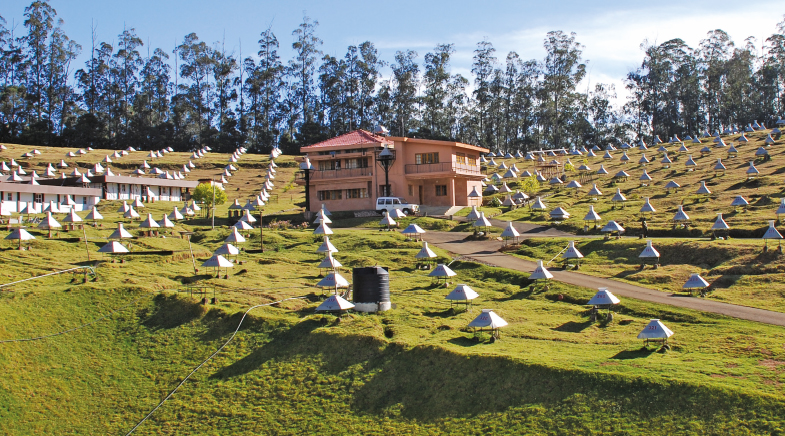
A recent study proves that ground-based space particle counters track Earth’s weather and solar storms in real time. The GRAPES-3 Muon Telescope in Ooty is cited as a ground-based tool for climate and solar weather monitoring.
GRAPES-3 Muon Telescope (Ooty):
| Dimension | Key Details |
|---|---|
| Observatory name | GRAPES-3 comprises the GRAPES‑3 (Gamma Ray Astronomy at PeV EnergieS) Observatory. |
| Type | GRAPES-3 comprises a cosmic-ray observatory. |
| Instrument scale | GRAPES-3 comprises the world’s largest tracking muon telescope. |
| Institutional control | Operations are governed by the Tata Institute of Fundamental Research (TIFR). |
| Location | The observatory applies to Ooty, Tamil Nadu. |
| Commissioning | The facility comprises commissioning in 2000. |
| Research collaboration | The research team comprises India and Japan. |
| Tracked particle | Tracking comprises cosmic muons, particles formed when cosmic rays hit the atmosphere. |
| Measured influences | Scientists’ measurements comprise upper-atmosphere temperature changes and the Sun’s magnetic field effects on muon numbers reaching Earth’s surface. |
| Monitoring utility | GRAPES-3 comprises daily counting of billions of muons for monitoring the upper atmosphere and the Sun’s magnetic field. |
| Atmosphere–muon link (positive observation) | Muon counts comprise a direct link with upper-atmosphere temperature: a warmer upper atmosphere expands outward, and fewer low-energy muons reach the ground. |
| Solar field–muon link (negative observation) | Muon counts comprise an inverse link with the Sun’s magnetic field: a stronger solar field blocks more cosmic rays, and fewer muons are detected. |
| Signal separation and filtering (neutral observation) | Signal separation is governed by Fast Fourier Transform (FFT) and repetitive algorithms, and filtering is governed by mathematical tools that filter out seasonal and solar cycle effects. |