|
CCRAS and CSU Launch 15-Day Udupi Workshop to Transliterate Ayurveda Manuscripts
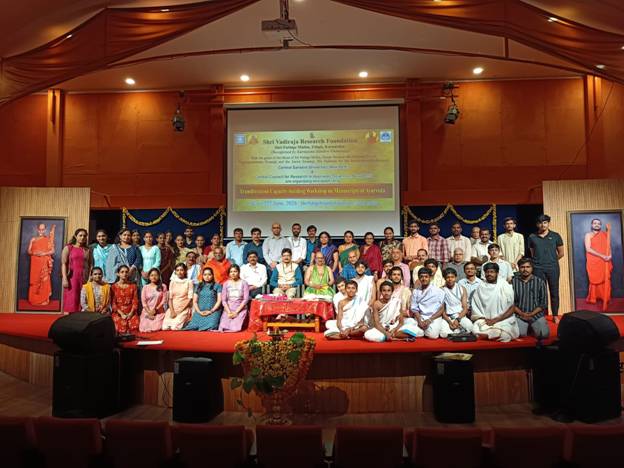
The Central Council for Research in Ayurvedic Sciences (CCRAS) and Central Sanskrit University (CSU) jointly launch a 15-day workshop at Udupi to transliterate Ayurveda manuscripts. The workshop runs under manuscript preservation programmes of the Gyan Bharatam Mission and covers specific scripts for transliteration.
CCRAS–CSU Ayurveda Manuscripts Transliteration Workshop (Udupi):
| Dimension | Key Details |
|---|---|
| Programme linkage | The initiative applies to a series of manuscript preservation programmes under the Gyan Bharatam Mission. |
| Objective | The initiative provides for building expertise among scholars to read, decipher, transliterate, and prepare rare unpublished Ayurveda texts for publication. |
| Scripts covered (Udupi workshop) | The Udupi workshop comprises scripts: Tigalari, and Old Kannada. |
| Earlier workshops (scripts and locations) | Earlier workshops have focused on Karani/Devanagari in Puri, Odisha; and Vattezhuthu/Malayalam in Guruvayur, Kerala. |
| Collaborators | The workshop comprises collaborators: CCRAS, CSU, and Sri Vadiraja Research Foundation. |
| Participants | The workshop comprises participants from Ayurveda colleges in Udupi and Hassan, and Sanskrit Gurukula students. |
| CCRAS role | CCRAS comprises the apex body for the formulation, coordination, development, and promotion of research on scientific lines in the Ayurveda system of medicine. |
| Nodal ministry | CCRAS is governed by the Ministry of Ayush. |
| CCRAS vision | CCRAS provides for integrating ancient wisdom with modern technology to develop evidence-based Ayurveda for diagnostics, prevention, treatment, and public health. |