|
Conservation Status of Gharial
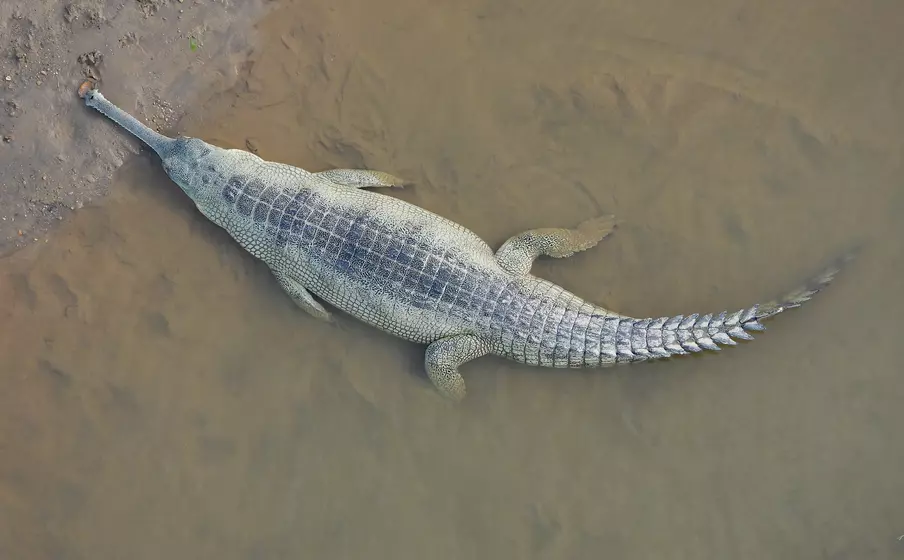
Recently, 31 gharial hatchlings have been released in the Bagaha area along the Gandak River in Bihar. The news highlights key facts on gharial habitat, distribution, and conservation status.
Gharial (Freshwater Crocodile):
| Dimension | Key Details |
|---|---|
| Taxonomy | Gharial is a freshwater crocodile belonging to the Crocodylia Order and Crocodylidae Family. |
| Name origin | The name ‘gharial’ comes from the Hindi word ghara, meaning pot or vessel, referring to the bulbous snout tip of adult males. |
| Habitat preference | Gharials inhabit deep, clear, freshwater rivers with sandy banks, primarily within Himalayan river systems. |
| Distribution (countries) | Gharial is mainly found in the rivers of Bangladesh, Bhutan, India, Myanmar, Nepal, and Pakistan. |
| Major population locations | The major population occurs in three tributaries of the Ganga River: the Chambal, the Girwa Rivers in India, and the Rapti-Naryani River in Nepal. |
| Largest wild population | The Chambal hosts the largest wild population of gharials. |
| Gharial reserves in India | The gharial reserves of India are located in three States: Uttar Pradesh, Madhya Pradesh, and Rajasthan. |
| Diet and ecological role | Gharials are predominantly piscivorous and play a key role in regulating fish diversity and maintaining riverine ecological balance. |
| Key physical features | Gharial is one of the largest crocodilians; has thick skin covered with smooth epidermal scales that do not overlap; has the thinnest and most elongated snout among crocodilians; adult males have a bulb at the snout tip called the ‘ghara’; is the most aquatic of all crocodilians and typically leaves water to bask and nest on sandbanks. |
| Reproduction | Gharials mate during November–January and lay eggs March–May. |
| IUCN Red List status | Gharial is listed as Critically endangered. |
| CITES status | Gharial is listed in Appendix I. |
| Wildlife Protection Act, 1972 status | Gharial is listed in Schedule I. |