|
Zoological Survey of India Records New Frog Species
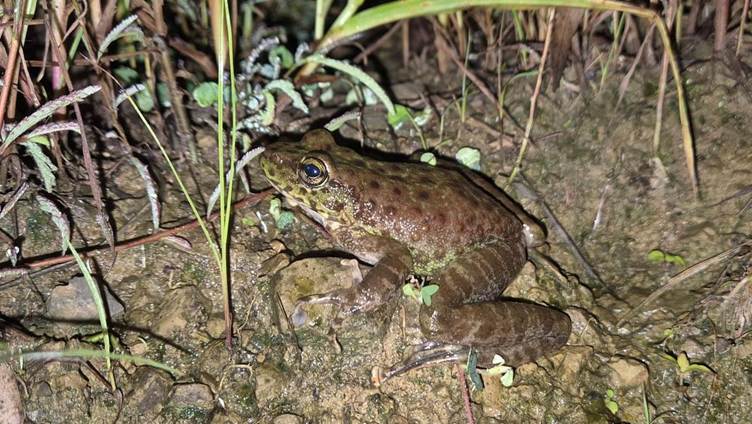
Scientists of the Zoological Survey of India record a new species of frog in Nagaland. The finding is relevant now because the species is identified as Nagaland Cascade Frog, with the scientific name Amolops kamal.
Nagaland Cascade Frog:
| Dimension | Key Details |
|---|---|
| Common Name | The common name of the species is Nagaland Cascade Frog. |
| Scientific Name | The scientific name of the species is Amolops kamal. |
| Taxonomic Classification | The species belongs to Kingdom Animalia, Phylum Chordata, Class Amphibia, Order Anura, and Family Ranidae. |
| Habitat | The frog inhabits hill-stream ecosystems. |
| Publication | The findings have been published in the journal Records of the Zoological Survey of India. |
| Nomenclature | The species has been named Amolops kamal in honour of Kamal Choudhury, who was the teacher and mentor of lead author Bhaskar Saikia. |
| Adaptation | The species is highly adapted to fast-flowing hill streams and waterfalls. |
| Key Features | The species has strong limbs, adhesive toe pads for gripping wet rocks, and extensive foot webbing. |
| Taxonomic Confirmation | Scientists have confirmed the distinct status of the species through integrative taxonomic analysis, including molecular phylogenetic studies. |
| Evolutionary Lineage | Amolops kamal represents a unique evolutionary lineage within the Amolops indoburmanensis species complex. |
| Cryptic Species Indication | Studies suggest that Amolops indoburmanensis, previously considered a single widespread species, may comprise several cryptic species distributed across Northeast India and neighbouring regions. |
| Global Amolops Diversity | The Asian genus Amolops contains 90 recognized species worldwide. |
| Indian Amolops Diversity | India reports 20 species of the genus Amolops. |
| Indian Amolops Groups | Indian Amolops are mainly grouped under Amolops marmoratus, Amolops monticola, and Amolops viridimaculatus, with the marmoratus group being the most diverse. |
| Research Relevance | The discovery contributes to taxonomic and conservation research. |