|
NASA’s Psyche Spacecraft Captures Rare Crescent Mars View
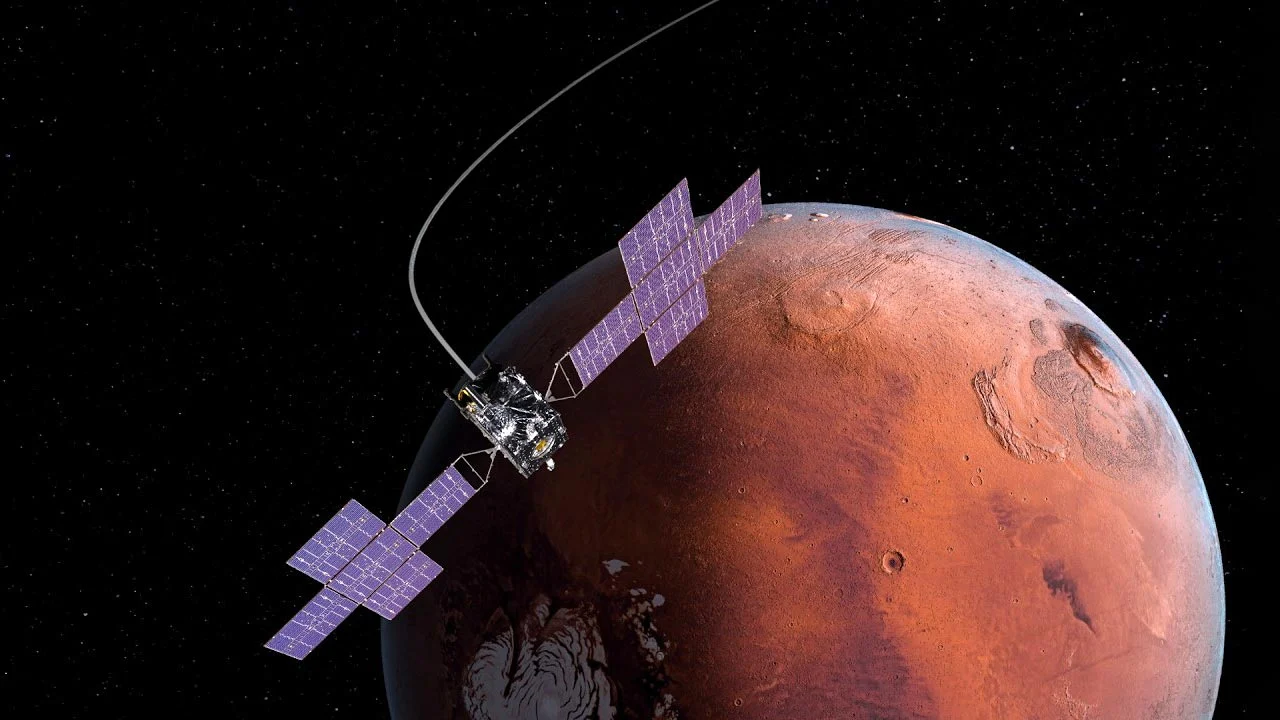
NASA’s Psyche spacecraft captures a rare crescent view of Mars during a gravity-assist flyby. The observation is relevant now because the spacecraft uses Mars’ gravitational pull to increase its speed and adjust its trajectory toward the metal-rich asteroid 16 Psyche.
NASA Psyche Mission and Mars Gravity-Assist Flyby:
| Dimension | Key Details |
|---|---|
| Flyby Date | Psyche passed within 4,609 km of the Martian surface on 15 May 2025. |
| Slingshot Maneuver | A slingshot maneuver is also known as a gravity-assist flyby or slingshot. |
| Gravity Assist | The maneuver used Mars’ gravitational pull to increase the spacecraft’s speed and adjust its trajectory toward its final destination. |
| Velocity and Orbital Change | The flyby boosted Psyche’s velocity by nearly 1,000 miles per hour and altered its orbital path around the Sun by about 1 degree. |
| Image Capture | The spacecraft used its multispectral imager to capture thousands of images of Mars, including a crescent view. |
| Crescent View | The crescent view was possible because Psyche approached Mars at a high phase angle, allowing sunlight to illuminate only a thin portion of the Martian disk. |
| Geological Features | The images revealed prominent geological features: the Huygens double-ring crater and the heavily cratered southern highlands. |
| Mission Agency | The Psyche Mission is launched by NASA. |
| Launch Date | The Psyche Mission was launched in October 2023. |
| Mission Objective | The Psyche Mission provides for exploration of the metal-rich asteroid 16 Psyche. |
| Asteroid Location | Asteroid 16 Psyche is located in the main asteroid belt between Mars and Jupiter. |
| Asteroid Composition | Asteroid 16 Psyche may be rich in iron and nickel. |
| Scientific Significance | Asteroid 16 Psyche could represent the exposed core of an early planetesimal and provide clues about the formation of rocky planets, including Earth. |
| Mission Distance and Arrival | The spacecraft is expected to travel more than 3.6 billion km and arrive at the asteroid in 2029. |
| Orbital Study Duration | The spacecraft will spend 2 years orbiting 16 Psyche after reaching its destination. |
| Study Methods | The mission will conduct detailed studies through imaging, surface mapping, and analysis of composition, magnetic properties, and internal structure. |