|
United States Operationalises NOAA’s SOLAR-1 Satellite
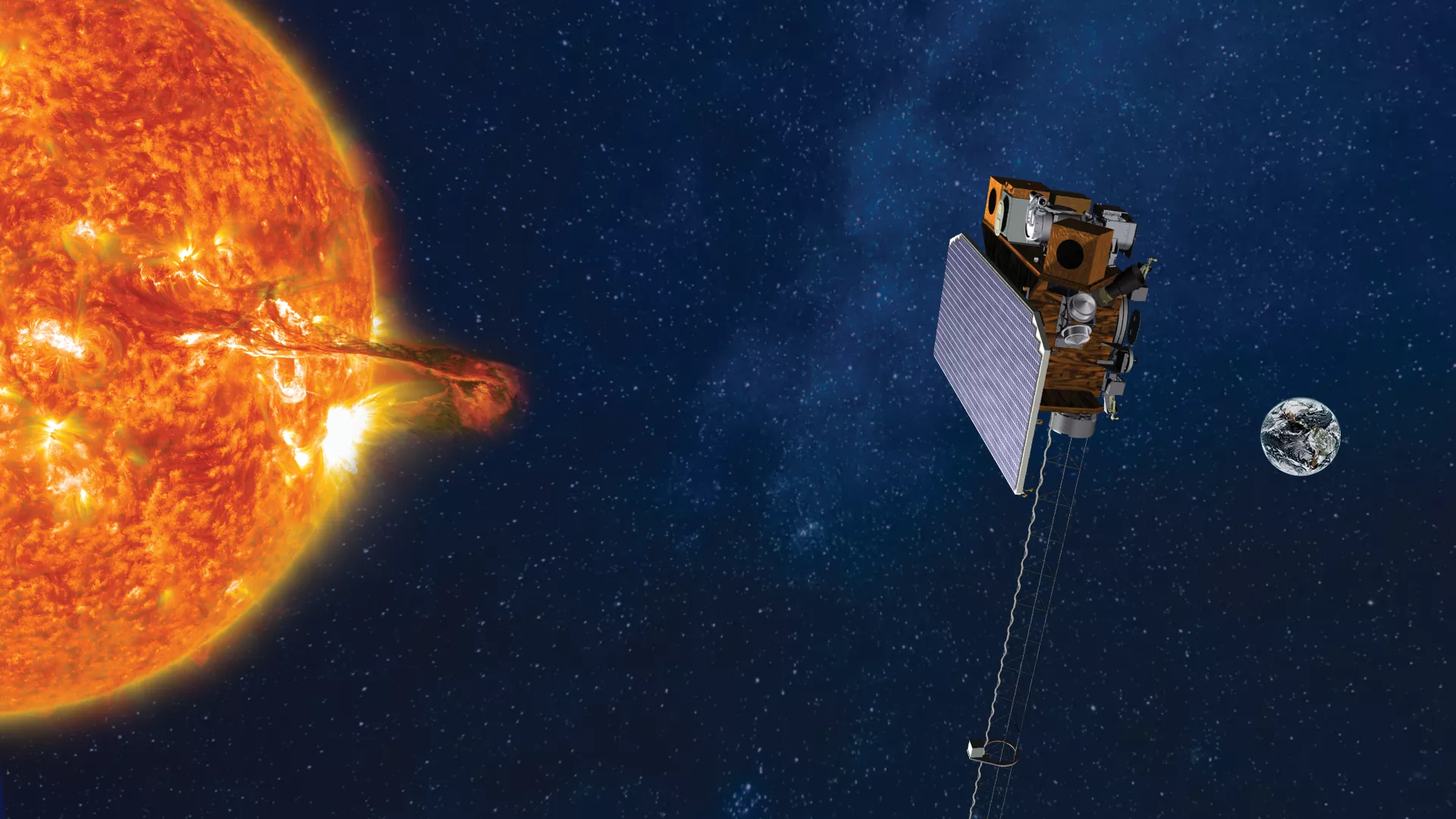
The United States operationalises SOLAR-1 (Space Weather Observations at L1 to Advance Readiness–1) for continuous space weather monitoring. The satellite is managed by the National Oceanic and Atmospheric Administration (NOAA) and is positioned at the Sun–Earth Lagrange Point 1 to provide early warnings of space weather events.
SOLAR-1 (Space Weather Observations at L1 to Advance Readiness–1) Satellite:
| Dimension | Key Details |
|---|---|
| Type | It is the first satellite exclusively dedicated to continuous space weather monitoring. |
| Earlier name | The satellite is initially known as Space Weather Follow-On – Lagrange 1 (SWFO-L1) before being renamed SOLAR-1. |
| Managing authority | It is managed by the National Oceanic and Atmospheric Administration (NOAA). |
| Launch date | It has been launched on 24 September 2025. |
| Launch vehicle | It has been launched using the Falcon 9 rocket. |
| Position | It is positioned at the Sun–Earth Lagrange Point 1, approximately 1.6 million kilometres from Earth in the direction of the Sun. |
| Location advantage | This location provides an uninterrupted view of solar activity while benefiting from gravitational stability, enabling efficient station-keeping with minimal fuel consumption. |
| Objective | It provides for continuous monitoring of solar phenomena and early warnings of space weather events. |
| Key instruments | It is equipped with a compact coronagraph telescope and advanced instruments. |
| Operational capabilities | It observes solar activity, measures solar wind conditions in real time, and tracks coronal mass ejections (CMEs) before they reach Earth. |
| CME imagery delivery time | It delivers CME imagery to NOAA’s forecasting systems within 30 minutes, compared to older systems that could take up to 8 hours. |
| Expected outcomes | This enhanced capability is expected to improve forecasting of auroras and strengthen the protection of critical infrastructure, including power grids, satellite networks, navigation systems, communication services, and space missions, from severe space weather impacts. |