|
Skyroot Aerospace Launches Vikram-1 Under Mission Aagaman for Small Satellites
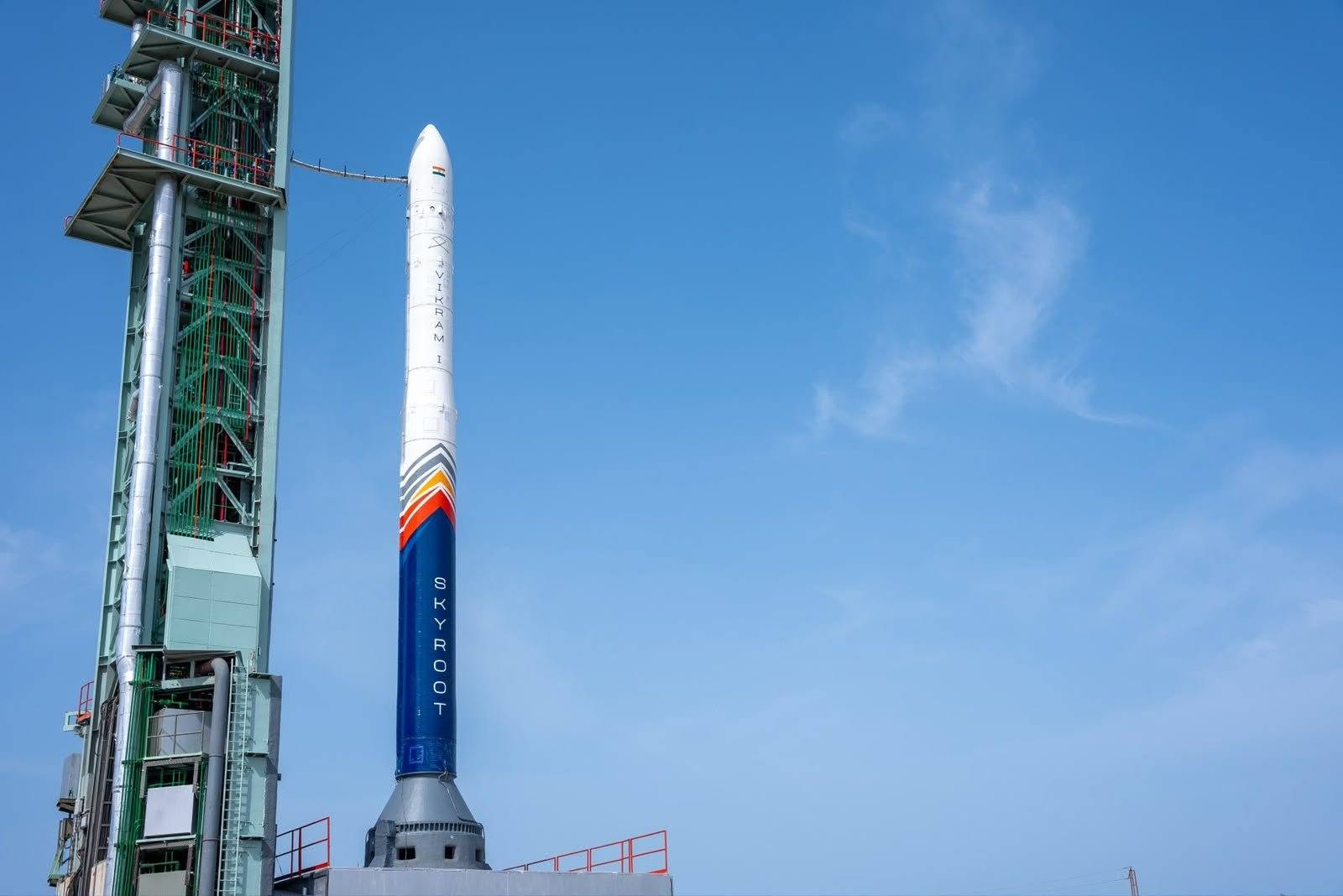
Skyroot Aerospace develops Vikram-1 under Mission Aagaman and demonstrates India’s capability for commercial, on-demand satellite launches by the private sector. India becomes the third country, after the United States and China, to have launching capabilities in the private sector.
Vikram-1 (Skyroot Aerospace) under Mission Aagaman:
| Dimension | Key Details |
|---|---|
| Developer and Mission | Vikram-1 is developed by Skyroot Aerospace under Mission Aagaman. |
| Manufacturing | Vikram-1 is fully designed and manufactured in India. |
| Deployment capability | Vikram-1 provides for small satellite deployment. |
| Payload capacity (LEO) | Up to 350 kg into Low Earth Orbit (LEO). |
| Payload capacity (SSO) | Up to 260 kg to Sun-Synchronous Orbit (SSO). |
| Structure | Vikram-1 comprises an all-carbon composite structure. |
| Rocket stages | Vikram-1 comprises a 4-stage rocket with 3 solid stages and 1 liquid stage. |
| Engine | Vikram-1 comprises a 3D-printed liquid-fuel engine. |
| Guidance and control | Vikram-1 comprises an autonomous Guidance, Navigation and Control (GNC) system powered by the Ramanujan mission computer. |
| Mission payloads | Mission payload comprises: SCOPE (Skyroot), Drishti (DCUBED technology demonstrator), SOLARAS S3 (Grahaa Space), and Embrace (Cosmoserve) robotic arm for space debris capture. |
| Symbolic payloads | Symbolic payloads comprise: Cosmic Bloom (floral-shaped artwork), and a gold micro-rocket with sculptures of C. V. Raman, Vikram Sarabhai, and A. P. J. Abdul Kalam. |
| India’s global position (private sector launch capability) | India becomes the third country, after the United States and China, to have launching capabilities in the private sector. |
| Global space economy share (India) | India accounts for around 2% of the global space economy. |
| Space startups (India) | Space startups increase from 1 in 2014 to nearly 400 in 2026. |
| Space economy valuation and projections (India) | Valuation and projections comprise: around USD 8.4 billion currently; USD 40–45 billion over the next decade; USD 100 billion by 2040. |