|
ISRO Qualifies Gaganyaan Crew Module Systems
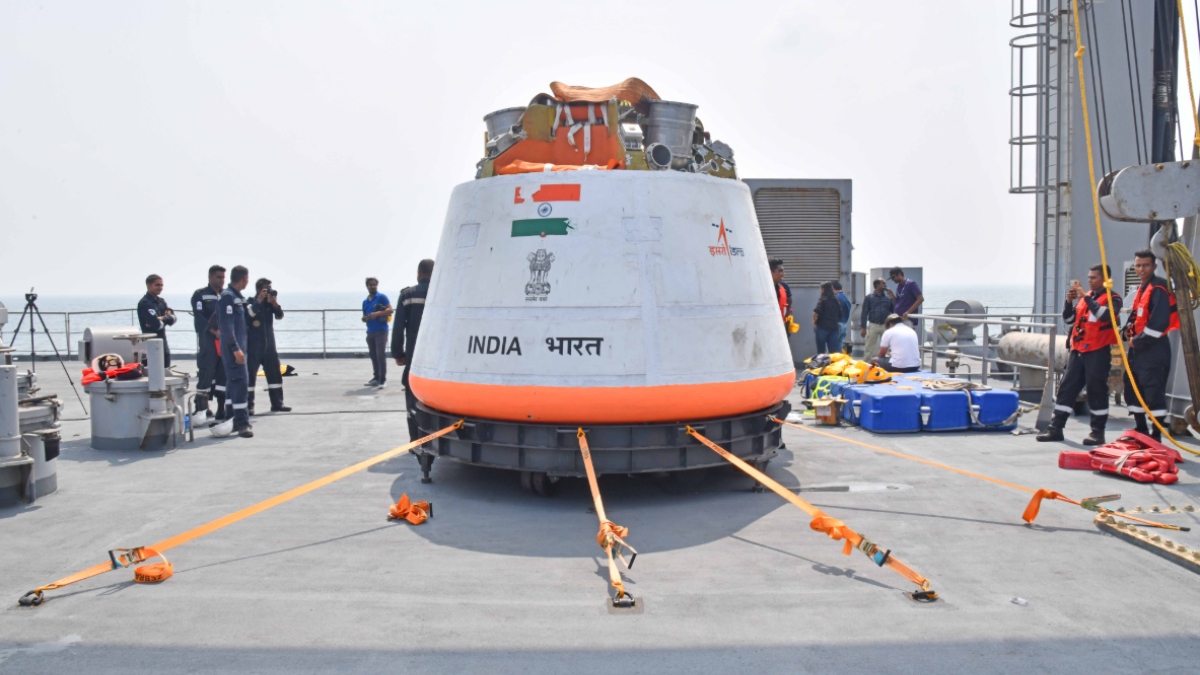
ISRO is conducting qualification of the Gaganyaan Crew Module (CM) systems by successfully carrying out 3 major qualification tests to validate astronaut safety and system performance. The news focuses on qualified subsystems, the CM’s selected truncated sphere-cone configuration, and key life-support, re-entry, and recovery mechanisms.
Gaganyaan Crew Module (CM):
| Dimension | Key Details |
|---|---|
| Qualified subsystems | Proven subsystems comprise the Crew Module Uprighting System (CMUS), the separation of the Crew-Service Umbilical mechanism (CSU-2), and the structural integrity during the Apex Cover Separation. |
| Spacecraft outer shape | The outer shape of a spacecraft dictates how it behaves physically when hitting the atmosphere at orbital velocities. |
| Design choice: spherical capsule | A spherical capsule comprises maximum internal volume for minimum structural mass, and it generates no aerodynamic lift, falling straight down and exposing astronauts to extreme G-forces. |
| Design choice: conical body | A conical body provides for high lift and aerodynamic stability for a controlled descent, and it is less volume-efficient. |
| Gaganyaan CM configuration | The Gaganyaan Crew Module comprises a truncated sphere-cone configuration weighing approximately 5.3 tonnes. |
| Environmental Control & Life Support (ECLSS) | ECLSS regulates oxygen supply, cabin pressure at 0.8 atm, temperature at 20–26°C, and humidity between 30% and 70%, and it comprises carbon dioxide scrubbing and waste control. |
| Thermal Protection System (TPS) | TPS comprises a thermal shield on the module’s exterior that safeguards the metallic pressure hull and the crew from re-entry heat loads exceeding thousands of degrees Celsius. |
| Deceleration system | The deceleration system comprises a highly redundant system utilising 10 different parachutes. |
| Crew Escape System (CES) | CES provides for a high-speed lifeboat function, and in case of catastrophic booster failure on the launchpad or during ascent, 5 quick-firing solid fuel motors pull the crew module away to safety. |
| De-orbit and CSU-2 separation sequence | The Service Module fires its propulsion system to decelerate the vehicle, and the Crew Module Umbilical (CSU-2) system executes separation by detaching the Service Module, which burns up in the atmosphere while the Crew Module proceeds alone. |
| Apex cover separation | Before the main parachutes deploy, the protective apex cover is cleanly jettisoned. |
| Parachute deployment and splashdown | The parachute sequence triggers to slow the module to terminal velocity before it splashes down in the ocean. |
| Active uprighting (CMUS) | CMUS comprises stored high-pressure cold-gas that inflates flotation devices to rotate the module back to an upright position to protect the crew and secure communication antennas. |