|
Hydrogen Fuel Cell Train
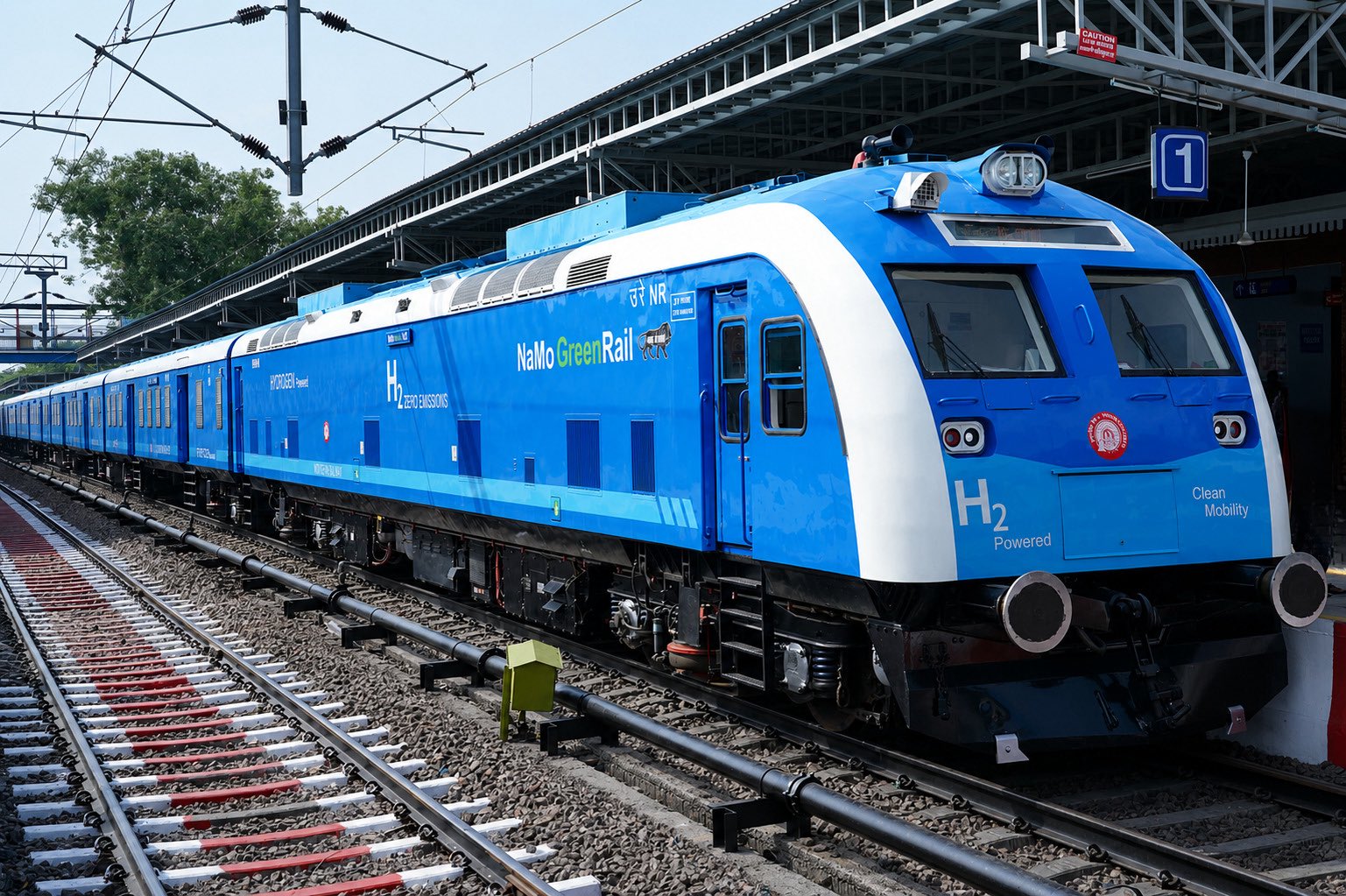
The Prime Minister flags off India’s 1st hydrogen-powered train between Jind and Sonipat in Haryana. The event marks India’s entry into a select group of countries operating hydrogen trains.
Hydrogen Fuel Cell Train (India’s 1st hydrogen-powered train):
| Dimension | Key Details |
|---|---|
| Technology | The train is powered by hydrogen fuel cell technology. |
| Power system configuration | The power system comprises two hydrogen driving cars, each producing 1,200 kW, supported by lithium iron phosphate batteries and hydrogen storage cylinders. |
| Refuelling ecosystem | India’s 1st integrated hydrogen railway ecosystem is at Jind, and it includes hydrogen production by electrolysis, and storage, compression, and refuelling at the same plant. |
| Train specifications | The train comprises 10 coaches, has a capacity of 2,600 passengers, operates at 75 kmph, and is designed for 110 kmph. |
| Global context | The global status comprises: Germany as pioneer; China as operational; France and Italy as rolling out; Japan, the US, the UK, and South Korea at pilot stage. |
| Global comparison | India’s train is the longest hydrogen train at 10 coaches and is among the most powerful at 3,200 HP globally. |
| Challenge: costs | Green hydrogen production, storage, and refuelling infrastructure are expensive. |
| Challenge: safety | Hydrogen is highly flammable and requires high-pressure storage and strict protocols. |
| Challenge: infrastructure | Hydrogen train operations require a reliable supply chain, trained manpower, and dedicated maintenance facilities. |