|
Scientists Discover Four New Nadzikambia Pygmy Chameleon Species
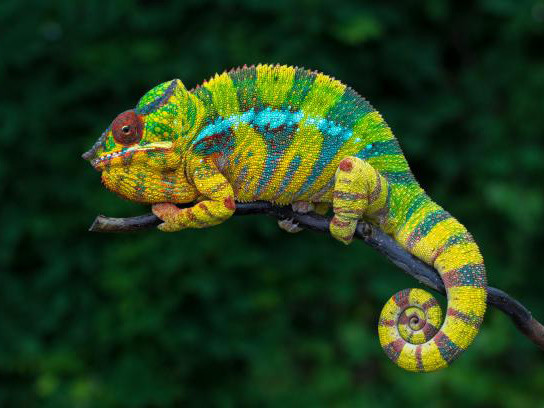
Scientists have recently discovered four new pygmy chameleon species in northern Mozambique’s isolated mountain ecosystems. The discovery is currently relevant for biodiversity conservation in sky island habitats.
Pygmy Chameleons and Sky Islands:
| Dimension | Key Details |
|---|---|
| Chameleons | Chameleons are specialised lizards from the Old World. |
| Colour Change | Chameleons change colour through special skin layers with tiny crystals, mainly for communication and body temperature regulation. |
| Pygmy Chameleons | Pygmy chameleons are miniature forest chameleons belonging mainly to the genera Rhampholeon and Nadzikambia. |
| Taxonomy | Pygmy chameleons belong to the order Squamata, family Chamaeleonidae, and genus Nadzikambia. |
| Morphology | Pygmy chameleons are small forest chameleons with cryptic colouration and camouflage abilities. |
| Habitat and Distribution | The newly identified species are endemic to high-altitude rainforest pockets of northern Mozambique. |
| Behaviour and Diet | Pygmy chameleons are arboreal, slow-moving, camouflage-reliant, and insectivorous. |
| Vision | Pygmy chameleons have independently movable eyes providing a nearly 360° field of view. |
| Reproduction | Pygmy chameleons are oviparous. |
| New Species | The four new species are Nadzikambia goodallae, Nadzikambia franklinae, Nadzikambia evanescens, and Nadzikambia nubile. |
| Nadzikambia goodallae | Nadzikambia goodallae is named after Jane Goodall and is endemic to one sky island with strong camouflage in dense montane rainforest. |
| Nadzikambia franklinae | Nadzikambia franklinae is named after Rosalind Franklin and shows subtle genetic and morphological divergence in scale pattern and body proportions. |
| Nadzikambia evanescens | Nadzikambia evanescens is named from evanescens meaning vanishing and is restricted to shrinking montane forest patches. |
| Nadzikambia nubile | Nadzikambia nubile is named from nubila meaning clouded and is adapted to high-altitude cloud-forest microclimates. |
| Sky Islands | Sky islands are isolated mountain ranges surrounded by different arid lowland environments, creating unique high-elevation habitats. |
| Sky Island Climate | Sky islands contain moist high-altitude zones that support rainforests even when surrounding lowlands are dry. |
| Evolutionary Significance | Isolation in sky islands drives speciation and results in high endemism. |
| Examples | Examples of sky islands include the Madrean Sky Islands in Arizona and Mexico and the Shola forests of the Western Ghats in India. |
| Ecological Importance | Sky islands act as natural research sites for studying speciation and are important for conservation biology due to high endemism. |