|
Virli Khandar Megalithic Site, Maharashtra
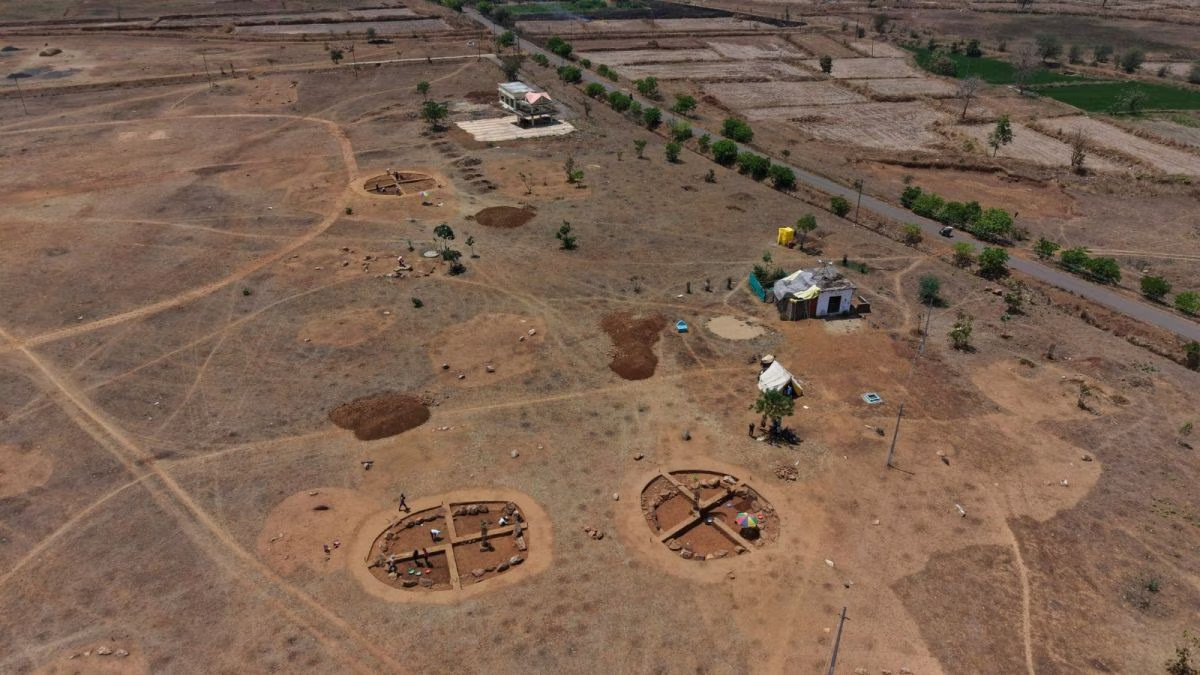
Recent excavation at Virli Khandar has revealed distinctive burial architecture, rare artefacts, and unusual pottery arrangements. The discovery is megalithic cultural practices in Vidarbha.
Virli Khandar Megalithic Site
| Dimension | Key Details |
|---|---|
| Site | Virli Khandar is a 2,500-year-old megalithic burial site first reported in 2008. |
| Location | The site is located in Pauni tehsil of Bhandara district in Maharashtra. |
| Burial Pattern | The site features composite megalithic structures comprising stone circles with menhirs placed inside. |
| Comparative Feature | The burial pattern differs from nearby sites such as Pimpalgaon Nipani and Tirota Kheri, which mainly feature dolmen burials. |
| Pottery Arrangement | Pots are found inverted and systematically arranged with larger bowls covered by smaller ones. |
| Soil Engineering | The pots are placed on black cotton soil laid over a natural lateritic or murum base for structural stability. |
| Artefacts | Artefacts comprise copper objects, iron implements, etched carnelian beads, a gold earring, and fragmentary bone remains. |
| Timeline | Preliminary observations date the site to around 500 BCE, while radiocarbon dating suggests a cultural sequence from 1000 BCE to 300 CE. |
| Menhirs | Menhirs are large man-made standing stones erected as monumental landmarks or as part of prehistoric megalithic complexes. |
| Largest Menhir | The Grand Menhir Brisé in Brittany, France, once stood at 20.6 m and is the largest surviving menhir. |
| India’s Tallest Menhir | The Nartiang Monoliths in West Jaintia Hills of Meghalaya comprise the tallest surviving menhir in India at approximately 8 m. |