|
Loktak Protocluster
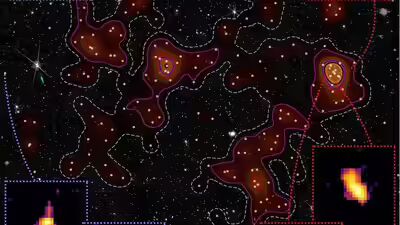
An Indian researcher based in Japan names a newly discovered large structure of galaxies as the “Loktak Protocluster,” after Manipur’s Loktak Lake. The discovery is led by Dr Ronaldo Laishram at the National Astronomical Observatory of Japan, using the Subaru Telescope and the James Webb Space Telescope.
Loktak Protocluster and Loktak Lake:
| Dimension | Key Details |
|---|---|
| Category | The Loktak Protocluster comprises a primitive galaxy cluster described by scientists as a “city of galaxies” that is still being built by the forces of gravity. |
| Discovery leadership and affiliation | The discovery is led by Dr Ronaldo Laishram, an astrophysicist from Manipur who is currently a researcher at the National Astronomical Observatory of Japan (NAOJ). |
| Age and cosmic timeline | The Loktak Protocluster is seen as it existed 12.6 billion years ago, when the universe is about 1.2 billion years old. |
| Telescopes used | The structure is studied using the Subaru Telescope in Hawaii and the James Webb Space Telescope. |
| Naming basis | The name reflects a parallel between Loktak’s connected phumdis and galaxy clusters. |
| Loktak Lake: status and location | Loktak Lake is the largest freshwater lake in Northeast India, located in Manipur’s Bishnupur district, about 45 km from Imphal. |
| Floating ecosystem (phumdis) | The lake’s surface features thick mats of vegetation called phumdis, comprising heterogeneous masses of vegetation, soil, and organic matter. |
| Keibul Lamjao National Park | Keibul Lamjao National Park is the world’s only floating national park, situated in the southeastern part of Loktak Lake. |
| Sangai habitat | Keibul Lamjao National Park comprises the last natural habitat of the endangered Sangai, the Manipuri brow-antlered deer. |