|
NASA James Webb Space Telescope maps extreme weather cycle on exoplanet WASP-94A b
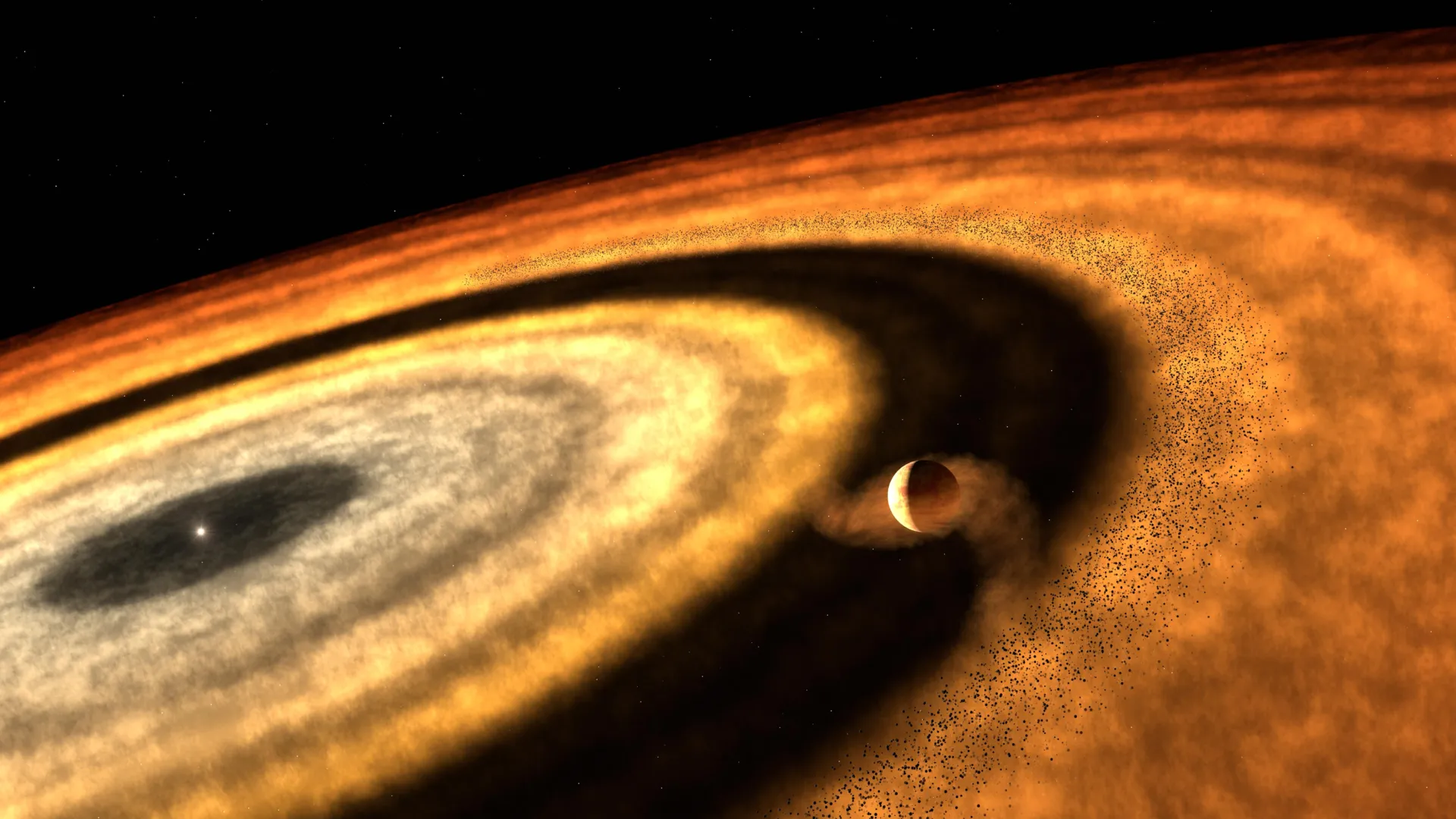
A recent study uses the NASA James Webb Space Telescope to observe WASP-94A b, an exoplanet nearly 700 light-years away. The scientists observed decipher weather patterns on the exoplanet and report the first direct measurement of such an extreme weather cycle on an exoplanet.
WASP-94A b and JWST Weather Observation:
| Dimension | Key Details |
|---|---|
| Celestial Body | WASP-94A b is an exoplanet and is described as a gas giant with scorching atmospheric temperatures. |
| Exoplanet | An exoplanet is any planet that exists outside the Solar System and orbits other stars, orbits binary star systems, or drifts freely through the cosmos as a rogue planet. |
| Category | WASP-94A b belongs to the category of hot Jupiters. |
| Distance | WASP-94A b is nearly 700 light-years away. |
| Size and Mass | WASP-94A b is almost twice as large as Jupiter and has only half the mass of Jupiter. |
| Orbit | WASP-94A b orbits very close to its parent star and takes 4 days to complete one revolution. |
| Tidal Locking | WASP-94A b has a tidally locked orbit, in which rotation is synchronised with revolution and the same side always faces the host star. |
| Weather System | WASP-94A b shows cloudy mornings and clear evenings. The morning limb is covered by mineral/silicate clouds, while the hotter evening limb has clearer skies. |
| Cloud Movement | The clouds likely form on the cooler night/morning side and evaporate as atmospheric circulation carries them toward the hotter dayside/evening limb. |
| Temperature Conditions | The planet has extreme temperature contrasts between its cooler morning/night-side regions and hotter day/evening-side regions, but the nightside is not close to absolute zero. |
| Temperature Conditions | The dayside has rock-melting temperatures, while the nightside remains pitch-dark and frozen, dipping close to absolute zero. |
| Detection Method | JWST uses spectroscopy, in which light is split into its various wavelengths and the intensity of each wavelength is measured. |
| Atmospheric Detection | An atmosphere absorbs some light and creates a gap in the set of wavelengths arriving at the spectrometer. |
| Current Finding | The study has reported the first direct measurement of such an extreme weather cycle on an exoplanet. |