|
Jammu and Kashmir Assembly Resolution Seeks Immediate Restoration of Statehood
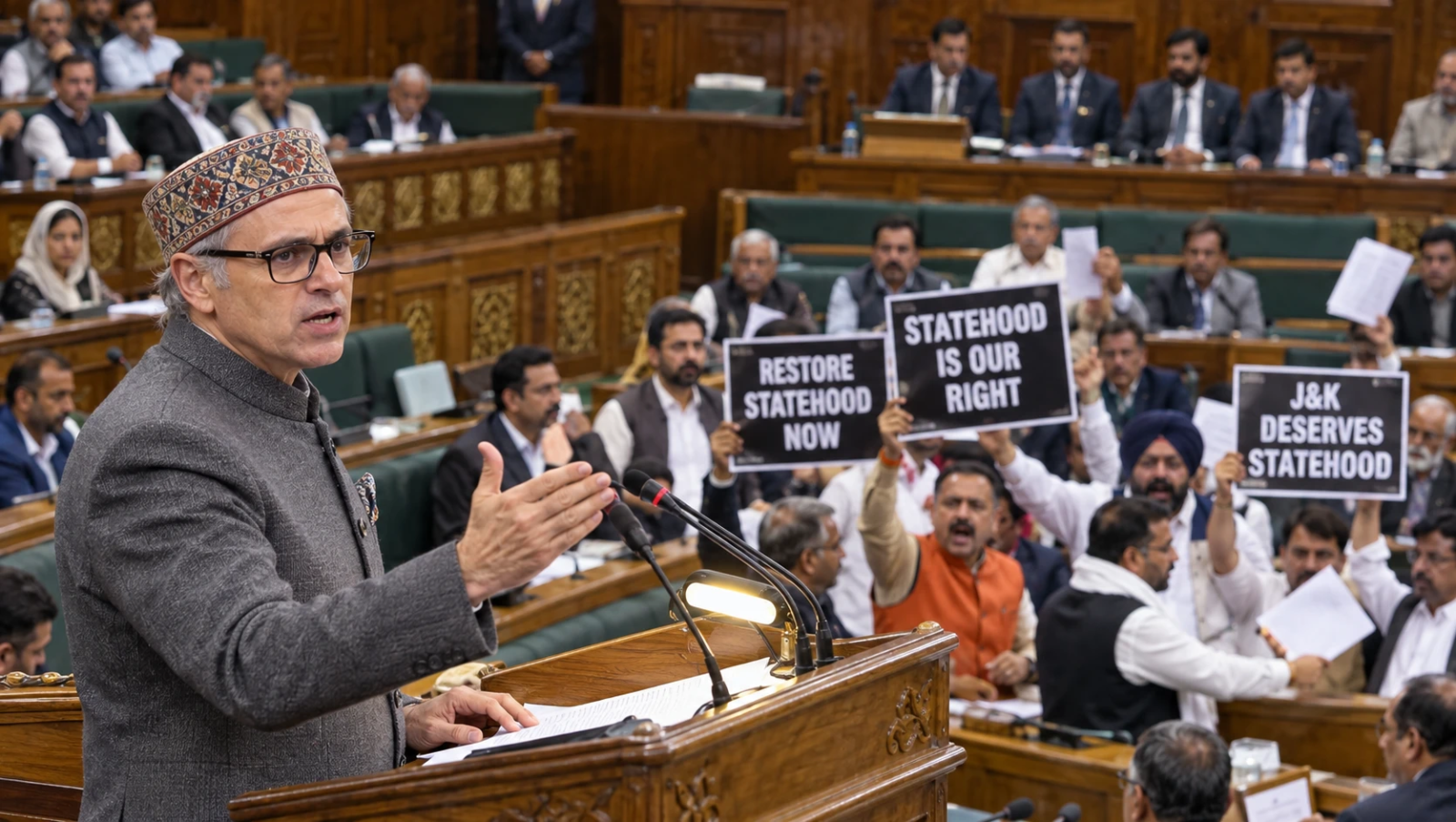
Jammu and Kashmir Chief Minister Omar Abdullah moves an Assembly resolution seeking immediate restoration of statehood for Jammu and Kashmir. Several amendments seeking inclusion of Articles 370 and 35A, as they existed before August 5, 2019, are moved and later withdrawn.
Article 370, Article 35A, and Abrogation Mechanism:
| Dimension | Key Details |
|---|---|
| Article 370 | Article 370 provides special status to Jammu and Kashmir, under which Parliament can legislate on only three subjects in relation to the state: Defence, Foreign relations, and Communication. |
| Instrument of Accession linkage | The three subjects under Article 370, Defence, Foreign relations, and Communication, are the exact subjects mentioned in the Instrument of Accession. |
| Article 370: constitutional position of J&K | Under Article 370, Jammu and Kashmir is allowed its own constitution, and only Article 1 and Article 370 apply to the state beyond the extension of subjects under the three specified heads. |
| Adoption date of Article 370 | Article 370 is adopted by the Constituent Assembly on October 17, 1949. |
| Article 370: restrictions | Under Article 370, outsiders require a permit to visit the state and are barred from buying land there. |
| Delhi Agreement, 1952 | Under the Delhi Agreement signed in July 1952, the state accepts the jurisdiction of the Supreme Court, accepts the supremacy of the Indian flag (with the state flag remaining in use too), and accepts the President’s power to declare Emergency under Article 352 only with the state’s concurrence in case of internal disturbances. |
| Article 35A: origin | A Presidential Order in 1954, issued under Article 370’s authority, adds Article 35A to the Constitution as an annexure (Appendix 1) to the official text. |
| Article 35A: powers and rights | Article 35A empowers the Jammu and Kashmir Assembly to define “permanent resident” of the state and provides special rights to such residents, including the right to own property and access to government jobs and scholarships. |
| Abrogation date and instrument | On August 5, 2019, the government renders Article 370 inoperative through the Constitution (Application to Jammu and Kashmir) Order, 2019, which supersedes the 1954 Order. |
| Effect of the 2019 Order | The 2019 Order nullifies Jammu and Kashmir’s separate constitution and extends all provisions of the Indian Constitution to the state. |
| Legal mechanism: Clause 3 of Article 370 | Clause 3 of Article 370 authorises the President to declare the article inoperative but mandates the “recommendation of the Constituent Assembly of the State”. |
| Legal mechanism: Clause 1 of Article 370 and Article 367 change | Clause 1 of Article 370 authorises the President to modify the Constitution’s application to Jammu and Kashmir, and the phrase “Constituent Assembly of the State” in Article 367 is replaced with “Legislative Assembly of the State”. |
| Legislative Assembly suspension and Governor reference | Since the state’s Legislative Assembly is suspended and the state is under President’s Rule after the BJP-PDP alliance collapses, the order specifies that any reference to the Legislative Assembly means a reference to the Governor of Jammu and Kashmir. |
| Judicial validation | The Supreme Court has upheld the abrogation in 2023, holding that Article 370 is meant to enhance integration between the Indian Union and Jammu and Kashmir, not cause disintegration. |
| UN involvement and UNSC Resolution 47 | India takes the matter to the UN Security Council in January 1948, the UN Commission for India and Pakistan (UNCIP) mediates a ceasefire, and UNSC Resolution 47 calls for both sides to demilitarise so a plebiscite can determine the wishes of Jammu and Kashmir’s people. |