|
Ranthambhore Tiger Reserve
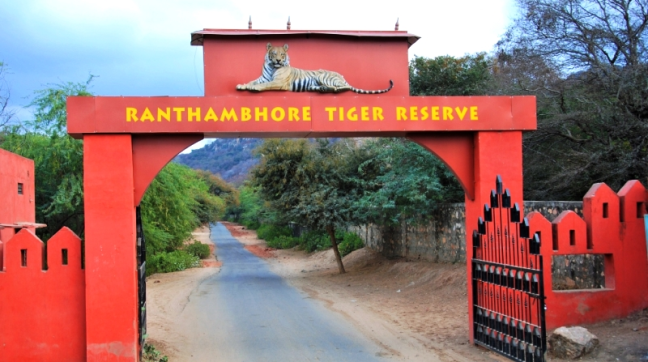
A captive-bred Indian vulture released in Maharashtra’s Melghat in January this year has covered 3,334 km across states and reaches the Ranthambhore Tiger Reserve in Rajasthan. The movement draws attention to Ranthambhore Tiger Reserve and its geographic and ecological features.
Ranthambhore Tiger Reserve:
| Dimension | Key Details |
|---|---|
| Location | It is located in the Sawai Madhopur district of southeastern Rajasthan. |
| Name origin | It derives its name from the Ranthambore Fort situated within its precincts. |
| Associated site | Ranthambore Fort is a World Heritage Site. |
| Physiographic setting | It is located at the junction (great boundary fault) of the Aravalis and Vindhyan ranges. |
| Past land-use note | The area is noted as a former royal hunting ground for the Maharajas of Jaipur. |
| Relative size | It is one of the largest tiger reserves in northern India. |
| Area | It spans an area of roughly 1,411 sq.km. |
| Landscape features | It comprises boulder-strewn highland plateaus, lakes, and rivers dotted with old forts and abandoned mosques. |
| Rivers (boundaries) | It is bounded to the north by the Banas River and to the south by the Chambal River. |
| Lakes | There are several lakes known as Padam Talab, Raj Bagh Talab, and Malik Talab. |
| Vegetation type | It comprises dry deciduous forests and open grassy meadow. |
| Flora | Flora comprises pure stands of Dhok tree (Anogeissus pendula) interspersed with grasslands at the plateaus, and species such as Acacia, Capparis, Zizyphus, and Prosopis. |
| Fauna (mammals) | Fauna comprises leopard, caracal, jungle cat, sambar, chital, chinkara, and wild boar. |
| Avifauna (examples) | Avifauna examples comprise peacocks, partridges, green pigeons, parakeets, sparrows, prinias, and warblers. |