|
Quad Foreign Ministers Back ASEAN Centrality, Support ASEAN Outlook on Indo-Pacific
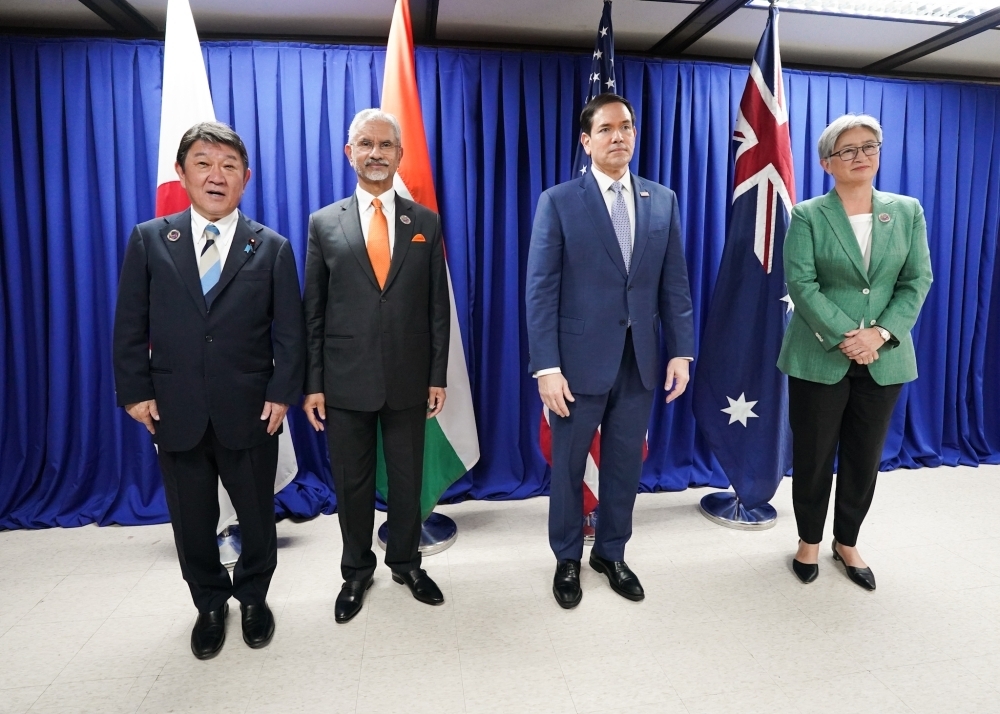
The Quad Foreign Ministers reaffirm support for implementing the ASEAN Outlook on the Indo-Pacific (AOIP). The statement reinforces ASEAN centrality and advances a free, open, and inclusive Indo-Pacific.
Quad Foreign Ministers on ASEAN Centrality and AOIP:
| Dimension | Key Details |
|---|---|
| ASEAN Centrality | ASEAN centrality comprises the leading role of ASEAN in shaping the regional architecture, agenda, and decision-making processes in the Indo-Pacific and the wider Asia-Pacific region. |
| ASEAN-led forums | ASEAN-led forums comprise the East Asia Summit (EAS) and ASEAN Regional Forum (ARF), and they provide an inclusive platform for dialogue among major powers. |
| Regional security platforms | ASEAN centrality provides a platform for dialogue and confidence-building through the ASEAN Regional Forum (ARF) and the ASEAN Defence Ministers' Meeting-Plus (ADMM-Plus). |
| Economic integration | ASEAN centrality leads regional economic cooperation through the Regional Comprehensive Economic Partnership (RCEP). |
| Rules-based regional order | ASEAN centrality promotes peaceful coexistence and international norms through the Treaty of Amity and Cooperation (TAC). |
| Challenges to ASEAN centrality | Challenges comprise U.S.–China rivalry; internal friction due to ASEAN's consensus-based, non-interference approach, including the Myanmar military coup crisis; and the rise of minilateralism through groupings such as the Quad and AUKUS that bypass ASEAN-led mechanisms. |
| Quad | The Quad comprises a plurilateral framework of maritime democracies and a Global Force for Good. |
| Quad objective | The Quad objective provides for delivering real, positive, and enduring impact for the Indo-Pacific. |
| Quad members | Quad members comprise Australia, India, Japan, and the United States. |
| Quad nature | The Quad comprises a diplomatic partnership, not a military alliance or mutual defence agreement. |