|
NITI Aayog Releases “Strategic Roadmap for Making Ayurveda Global”
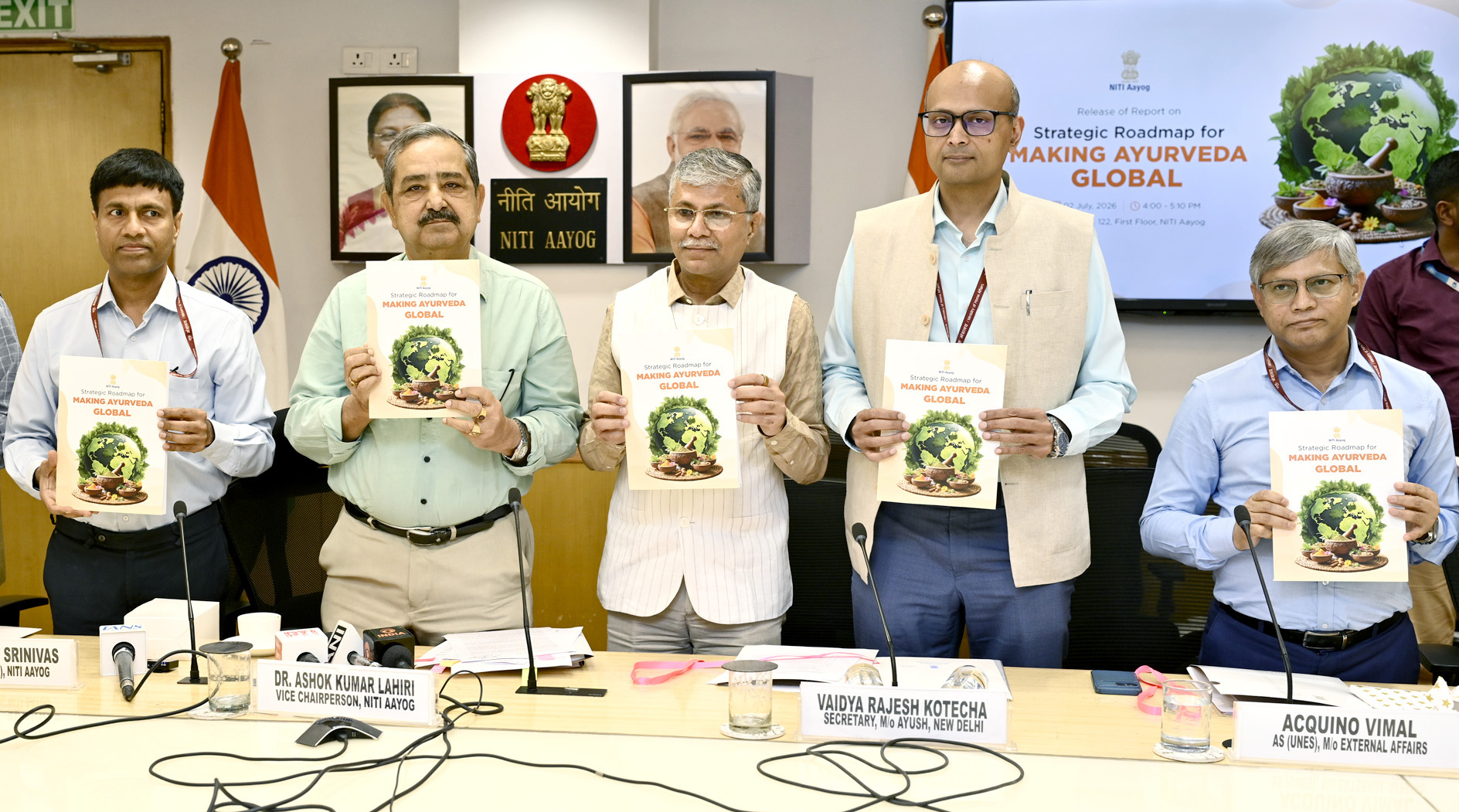
NITI Aayog releases a report titled “Strategic Roadmap for Making Ayurveda Global” on July 2, 2026. The report presents a three-pillar framework and an implementation roadmap for expanding Ayurveda’s global footprint.
Strategic Roadmap for Making Ayurveda Global :
| Dimension | Key Details |
|---|---|
| Issuing authority | The report is released by NITI Aayog. |
| Title and date | The report is titled “Strategic Roadmap for Making Ayurveda Global” and has been released on July 2, 2026. |
| Ayush and herbal export figures | India’s Ayush and herbal exports increase from $1.09 billion in 2014 to $2.16 billion in 2023, covering over 150 countries. |
| WHO ICD-11 integration | Ayurveda, along with Siddha and Unani systems, is integrated into the WHO International Classification of Diseases-11 (ICD-11) under the Traditional Medicine module. |
| Recognition as official discipline | Ayurveda is recognized as an official medical discipline in nearly 30 countries, including UAE and Switzerland. |
| Practitioner distribution | India has over 355,000 qualified practitioners in India, and 95% remain within the country. |
| Competition reference | The report states that Ayurveda faces tough competition from Traditional Chinese Medicine (TCM), which has a vastly dominant global export share and licensed workforce. |
| Framework | The report comprises a three-pillar framework: Availability, Acceptability, and Propagation. |
| Availability pillar: Global Ayurveda Register (GAR) | The Global Ayurveda Register (GAR) provides for a digital, WHO-aligned credentialing and Continuous Professional Development (CPD) system under the National Commission for Indian System of Medicine (NCISM) to facilitate foreign practitioner licensure. |
| Availability pillar: Trade dashboard | The report provides for a real-time Ayurveda Trade Dashboard using precise Harmonized System (HS) codes to track and leverage Free Trade Agreements (FTAs). |
| Availability pillar: Standardized sourcing | The report provides for enforcing Good Agricultural and Collection Practices (GACP) to eliminate heavy metals, pesticides, and microbial contaminants at the source. |
| Acceptability pillar: Export edition pharmacopoeia | The report provides for creating an exclusive international edition of the Ayurvedic Pharmacopoeia to establish chemical profiling and batch-to-batch consistency. |
| Acceptability pillar: Manufacturing compliance | The report provides for fast-tracking compliance of domestic units with WHO-Good Manufacturing Practices (WHO-GMP) standards. |
| Acceptability pillar: Multi-country clinical trials | The report provides for conducting multi-country clinical trials via WHO Collaborating Centres to bridge the “evidence gap” and move products from the “dietary supplement” tag to formal therapeutic drug classification. |
| Propagation pillar: Medical Value Travel (MVT) | The report provides for establishing international Ayurveda Medical Value Travel (MVT) hubs, starting with Mauritius, integrated with Ayush Visa packages, diagnostics, and tele-consultation support. |
| Propagation pillar: Global forums and TKDL | The report provides for proposing a World Federation for Ayurveda and Yoga, and modernising India’s Traditional Knowledge Digital Library (TKDL) to secure intellectual property (IP) rights and prevent biopiracy. |
| Implementation roadmap: Short-term | The short-term roadmap (up to 2029) provides for institutional foundation-building, deploying the Global Ayurveda Register, and establishing quality testing protocols. |
| Implementation roadmap: Medium-term | The medium-term roadmap (up to 2035) provides for market integration through mutual recognition arrangements (MRAs) with regional blocs, including G20, BRICS, and ASEAN, and introducing Ayurveda electives in global medical institutes. |
| Implementation roadmap: Long-term | The long-term roadmap (up to 2047) provides for formal integration of Ayurveda into at least 20 national health systems and securing insurance coverage for defined Ayurvedic indications in at least 10 countries. |