|
Indian team discovers rare ‘bow and arrow’ radio galaxy 2 billion light years from Earth
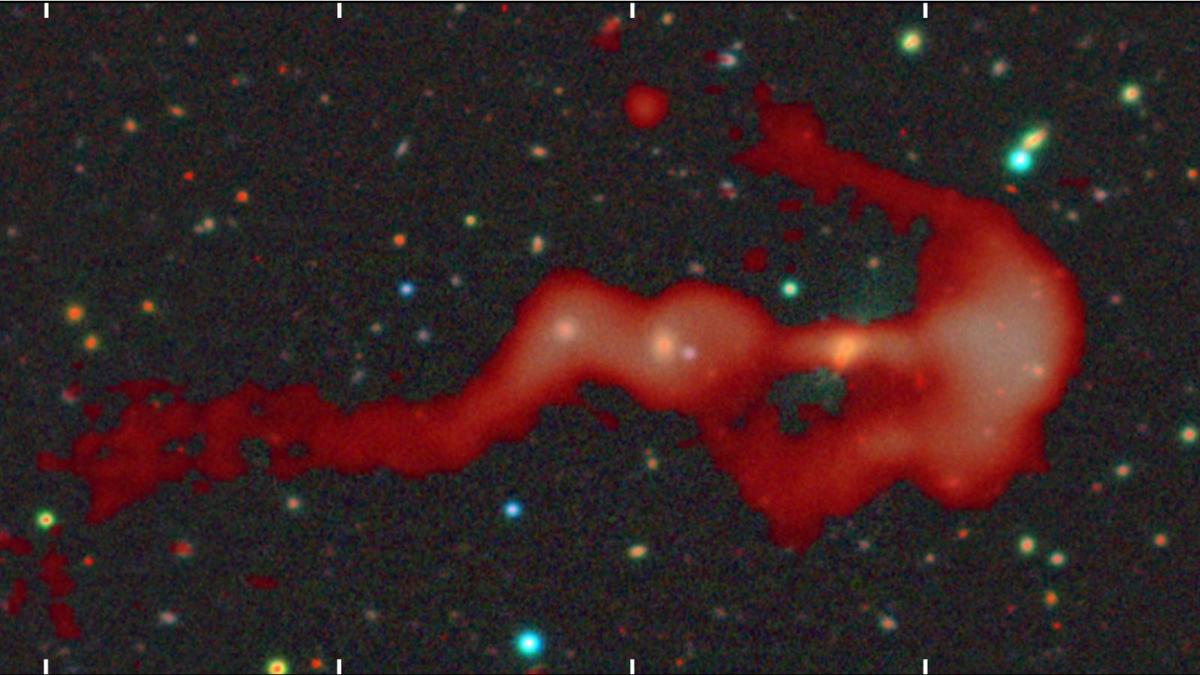
Twelve Indian researchers across 3 countries discover a rare bow-and-arrow shaped radio galaxy named RAD-BAARG about 2 billion light years from Earth. The object is identified using ultra-sensitive images from the LOFAR Two-metre Sky Survey, a deep low-frequency radio survey.
RAD-BAARG (Bow and Arrow Radio Galaxy):
| Dimension | Key Details |
|---|---|
| Discovery | 12 Indian researchers across 3 countries have discovered a rare bow-and-arrow shaped radio galaxy named RAD-BAARG. |
| Discovery location | The radio galaxy is located about 2 billion light years from Earth. |
| Nomenclature | RAD refers to RAD@home Astronomy Collaboratory, and BAARG stands for Bow and Arrow Radio Galaxy. |
| RAD@home | RAD@home Astronomy Collaboratory comprises India’s first citizen science research platform in astronomy. |
| Identification method | The radio galaxy is identified using ultra-sensitive images from the LOFAR Two-metre Sky Survey (LoTSS). |
| LOFAR Two-metre Sky Survey (LoTSS) | LoTSS comprises a deep low-frequency radio survey and acts as a cosmic mapmaker that takes pictures of space using radio waves instead of normal light. |
| Radio galaxy: defining feature | A radio galaxy comprises a galaxy whose central supermassive black hole drives active galactic nuclei (AGN) to eject two oppositely directed, ultra-powerful jets of relativistic, magnetized plasma into intergalactic space. |
| Typical morphology vs RAD-BAARG | Typical radio galaxies project symmetric, mirror-image beams, but RAD-BAARG is heavily distorted by violent external environmental pressures. |
| Shape and size | RAD-BAARG comprises a bow-and-arrow shape and is 1.8 million light years wide. |
| Asymmetric nature | RAD-BAARG comprises asymmetric features compared with normal radio galaxies. |
| Environment | RAD-BAARG is located within a highly active, complex multi-halo galaxy cluster environment. |
| Supersonic infall | The host galaxy is falling toward the high-gravity center of a massive nearby galactic cluster. |
| Intracluster medium interaction | The galaxy travels at supersonic speeds through a dense, hot intracluster medium, faster than the speed of sound within that medium. |
| Bow shock wave visibility | The galaxy’s motion creates a massive bow shock wave, and relativistic plasma particles have collided with and illuminated the compressed shock front, rendering the interaction visible to radio telescopes. |