|
Researchers Revalidate Himalayan Pangolin
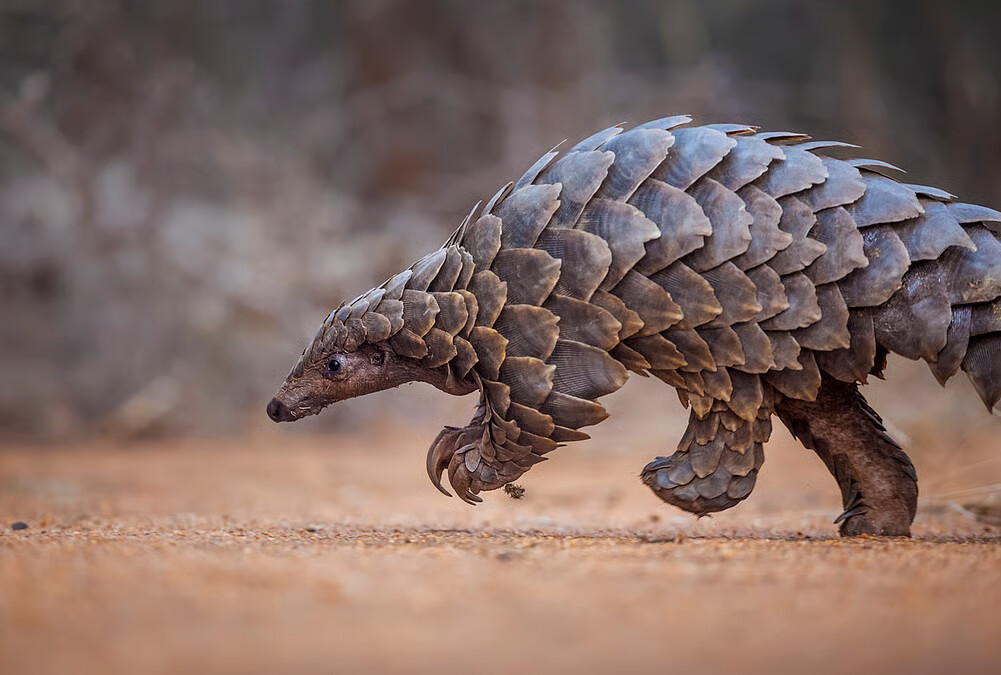
Researchers revalidate the Himalayan pangolin as a distinct extant species, separate from the Chinese pangolin (Manis pentadactyla). The study cites extensive genomic and morphological evidence and reports its restricted distribution in the southern Himalayan foothills.
Himalayan Pangolin (Manis aurita):
| Dimension | Key Details |
|---|---|
| Scientific name | Manis aurita. |
| Family | All pangolins belong to Family Manidae. |
| Type | It is a cryptic, nocturnal, scaly ant-eating mammal. |
| Species status | Extensive genomic and morphological evidence suggests it is a distinct extant species, previously classified as a subspecies of the Chinese pangolin (Manis pentadactyla). |
| Distribution | It is restricted to the southern Himalayan foothills, with confirmed populations in Nepal, South Tibet, and Northeast India, including the state of Assam. |
| Morphological comparison with Chinese pangolin | It is significantly larger in body size and skull, is larger on average (95.2 cm) compared to 71.2 cm for the Chinese pangolin, and has smaller ears and a shorter and broader nasal bone. |
| Divergence factor (study) | Climate change played a key role in diverging the two lineages approximately 1.8 million years ago during the early Pleistocene Epoch. |
| Demographic finding (study) | Around the 14th century, it undergoes a sharp demographic collapse due to intense cooling and aridification. |
| China comparison (climatic context) | Unlike the Chinese pangolin, which benefits from stable maritime-influenced forests in southern China, Manis aurita lacks climatic buffering, faces habitat instability, and undergoes long-term decline. |
| IUCN status | It has not been separately assessed by the IUCN. |
| CITES status | It is listed in Appendix I. |
| WPA, 1972 status | It is listed in Schedule I. |
| Threats | Threats comprise illegal wildlife trade for meat, organs, skin, scales, and other body parts valued for use in traditional medicine, and internal threat of inbreeding. |