|
India-Nepal Border Dispute
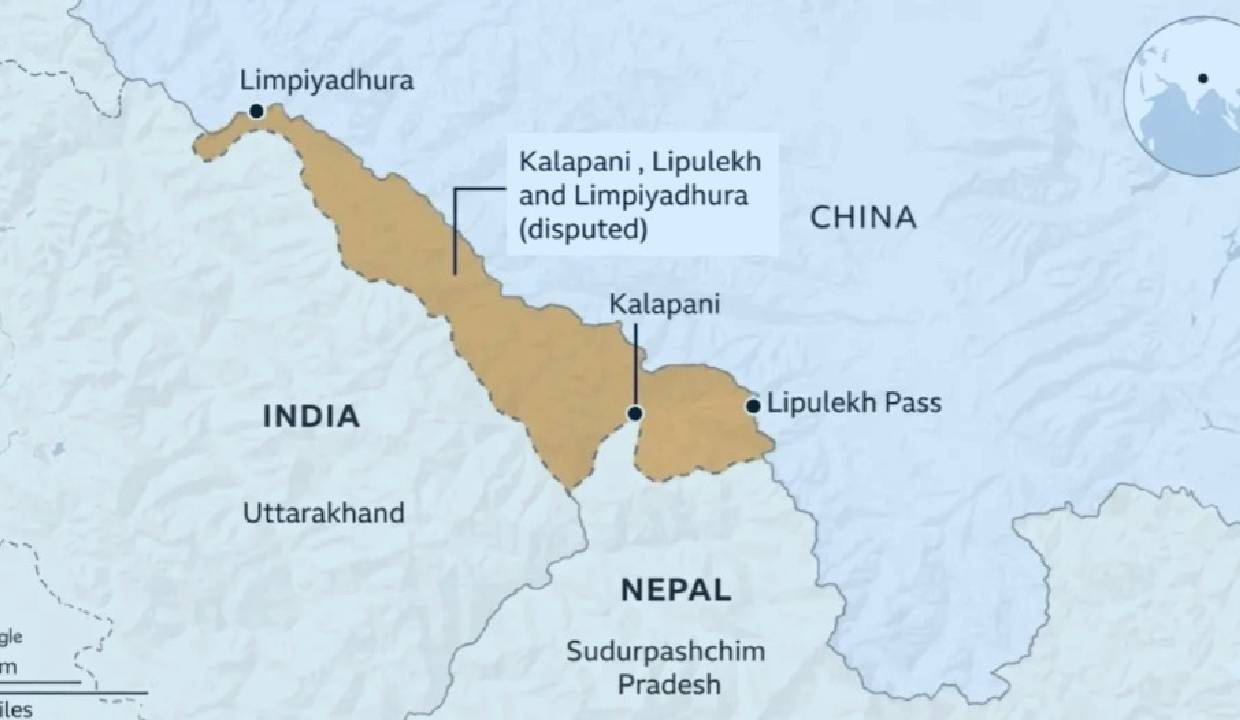
Recent remarks by Nepal Prime Minister Balendra Shah in Nepal’s Parliament renew attention on unresolved India-Nepal boundary issues and trigger political debate in Nepal. Nepal has sent a diplomatic note to India on disputed territories including Lipulekh, and both sides agree to pursue dialogue-based solutions.
India-Nepal Boundary Dispute:
| Dimension | Key Details |
|---|---|
| Border extent and Indian states | India and Nepal share an open international border of nearly 1,850 km across Uttarakhand, Uttar Pradesh, Bihar, West Bengal, and Sikkim. |
| Status of demarcation | Most of the boundary is demarcated, and a few segments remain disputed. |
| Treaty basis cited | The Treaty of Sugauli (1816) signed between the East India Company and Nepal identifies the Kali (Mahakali) River as the western boundary of Nepal. |
| Core disagreement | Disagreements exist on the exact source of the Kali (Mahakali) River, leading to competing territorial claims. |
| Disputed area: Kalapani | Kalapani is located near the India-Nepal-China tri-junction, India administers it as part of Uttarakhand, and Nepal claims it as part of its Darchula district. |
| Disputed area: Lipulekh Pass | Lipulekh is a mountain pass connecting India with Tibet, serves as a route for the Kailash Mansarovar Yatra and border trade with China, and Nepal claims it as part of its sovereign territory. |
| Disputed area: Limpiyadhura | Nepal argues that the Kali River originates from Limpiyadhura, which places Kalapani and Lipulekh within Nepalese territory, and India disputes this interpretation. |
| 2020 political map issue | In 2020, Nepal has issued a new political map incorporating Kalapani, Lipulekh, and Limpiyadhura within its territory, and India has rejected this as a unilateral action inconsistent with historical facts and existing understandings. |
| Resolution mechanisms | India and Nepal generally favour a peaceful and diplomatic approach through bilateral dialogue, joint boundary mechanisms, survey and mapping exercises, and historical and cartographic examination by experts. |
| Recent parliamentary statement by Nepal PM | Nepal Prime Minister Balendra Shah states that the border issue may not be entirely one-sided and mentions possible locations where Nepal occupies land claimed by India. |
| Diplomatic note and response | Nepal has formally sent a diplomatic note to India regarding territories Kathmandu considers disputed, including Lipulekh, and Shah states that India responds positively with agreement to pursue dialogue-based solutions. |
| Proposed expert teams | Future discussions could involve teams comprising historians, surveyors, and boundary experts. |
| Third-party references in Nepal PM remarks | Shah states that Nepal has discussed the boundary issue with China and the United Kingdom, and India maintains that bilateral boundary issues should be resolved directly between India and Nepal without third-party involvement. |
| Extent resolved | Former Nepal ambassador to India Nilambara Acharya states that nearly 97% of the India-Nepal boundary issues are resolved, with only a limited number of disputed segments remaining. |
| Boundary pillars and cultivation across border | Farmers cultivating land across the border due to damaged or missing boundary pillars should not be interpreted as state-sponsored territorial encroachment. |
| Recent Lipulekh route objection | Nepal objects to the resumption of the Kailash Mansarovar Yatra route through Lipulekh Pass, and India rejects the objection as a unilateral expansion of territorial claims. |