|
Golden Langur conservation status
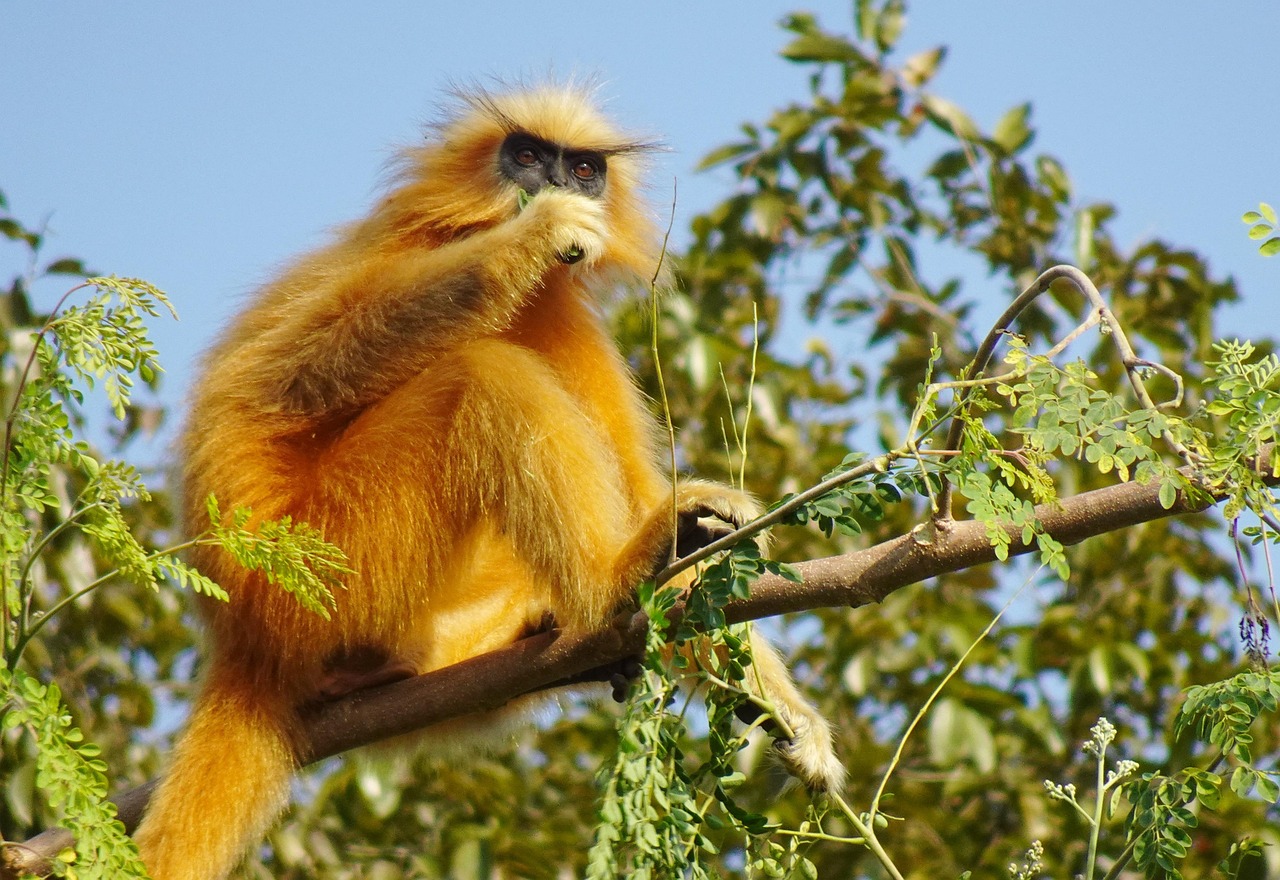
7 endangered Golden Langurs are successfully released back into the wild at Sikhna Jwhwlao National Park in Assam following a joint anti-trafficking operation. The development brings focus to the Golden Langur’s identification features, restricted distribution, and legal protection status.
Golden Langur (Trachypithecus geei):
| Dimension | Key Details |
|---|---|
| Taxonomy | Golden Langur is an Old-World monkey and belongs to the family Cercopithecidae (Old World Monkeys). |
| Scientific name | The scientific name of Golden Langur is Trachypithecus geei. |
| Discovery | The species is discovered in 1953 by the naturalist E.P. Gee. |
| Morphology | It is a medium-sized arboreal primate; weight is 9.5–10.8 kg; height is 50–75 cm in head-and-body length; tail is a very long, non-prehensile tail measuring 70–100 cm. |
| Unique traits | It has striking golden-orange fur with seasonal colour changes from dark chestnut in winter to cream-coloured in summer, and it has a completely hairless, jet-black face framed by a long, pale beard. |
| Habitat | It inhabits high-canopy subtropical moist deciduous and evergreen forests and is highly dependent on contiguous riverine forest ecosystems. |
| Distribution | It is endemic to a very small region split between Western Assam, India, and the neighbouring Black Mountains of Bhutan. |
| Geographical boundaries | Its range boundaries are: North, foothills of the Black Mountains in Bhutan; South, the Brahmaputra River in Assam, India; East, the Manas River; West, the Sankosh River. |
| Diet and feeding adaptation | It is a herbivore (folivore) with a specialized, multi-chambered tripartite (three-chambered) stomach that utilizes unique microflora to ferment and digest tough cellulose from leaves, fruits, seeds, and buds. |
| IUCN Red List status | Golden Langur is listed as Endangered on the IUCN Red List. |
| Wildlife (Protection) Act, 1972 | It is listed in Schedule I of the Wildlife (Protection) Act of India, 1972, offering the highest level of legal protection against hunting and trade. |
| CITES status | It is listed in CITES Appendix I. |
| Threats | Threats comprise habitat fragmentation, human-wildlife conflicts, and genetic isolation. |