|
Francis Halzen honoured for IceCube neutrino observatory
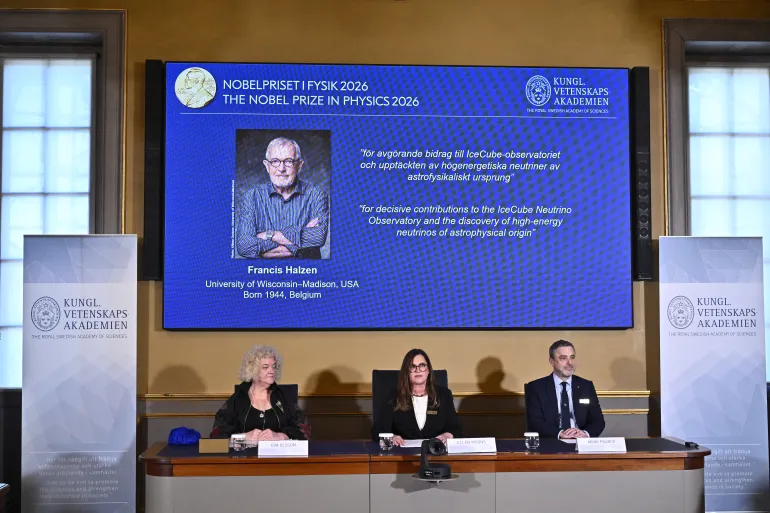
The 2026 Nobel Prize in Physics is awarded to Belgian-American scientist Francis Halzen for designing the IceCube neutrino observatory beneath Antarctic ice sheets to capture neutrinos. IceCube is in the news for detecting high-energy neutrinos arriving from far outside the Milky Way, described as extra-galactic neutrinos.
IceCube Neutrino Observatory and Neutrinos:
| Dimension | Key Details |
|---|---|
| Neutrinos: nature and origin | Neutrinos are very small subatomic particles, produced mainly in nuclear reactions inside stars. |
| Neutrinos: abundance | They are among the most abundant particles in the universe, second only to photons. |
| Neutrinos: interaction property | Neutrinos have an extremely low propensity to interact with matter. |
| Neutrinos: electric charge | They are electrically neutral, so they do not respond to electromagnetic fields like charged particles do. |
| Quantitative fact | Nearly 65 billion neutrinos pass through a human fingernail every second, completely unnoticed. |
| Detection constraint | Detection happens only on rare occasions when neutrinos interact with matter, perhaps one in billions or trillions. |
| Neutrino observatories | Neutrino observatories worldwide comprise very large facilities in extremely isolated, often underground locations to maximise interaction chances and minimise background noise. |
| IceCube: uniqueness | IceCube achieves detection of high-energy neutrinos arriving from far outside the galaxy, described as extra-galactic neutrinos. |
| Earlier detection constraint | Previously, scientists can detect neutrinos originating close to Earth, primarily produced by nuclear processes inside the Sun. |
| Location rationale | The South Pole location works because it is isolated, and at significant depths, there is extensive darkness with no disturbance from other radiation or signals. |
| IceCube: physical setup | The detector setup comprises 1 cubic kilometre of ice with over 5,000 light sensors mounted on long cables, and an overground facility that collects and processes signals. |
| Detection mechanism | When a neutrino interacts with an ice atom’s nucleus, it produces a charged particle, and if that particle travels faster than the speed of light in ice, it produces a faint glow related to Cherenkov radiation. |
| Reconstruction method | By analysing the glow’s characteristics, scientists can reconstruct the energy and direction of the original neutrino. |
| IceCube: operational timeline and results | IceCube has become fully operational in 2011, has presented first evidence of very high-energy neutrinos in 2013, and since then several such detections have been recorded and independently verified. |
| Multi-messenger astronomy | Multi-messenger astronomy comprises the use of multiple independent signals for the same cosmic event, including visible light, full electromagnetic spectrum detectors (and cosmic ray detectors), gravitational waves (detected in 2015), and extra-galactic neutrinos. |
| India-based Neutrino Observatory (INO): project status | The INO project is initially planned for Kerala, is relocated to Tamil Nadu, runs into opposition over land acquisition and environmental concerns, and a new location has yet to be finalised. |