|
Crop Residue Management Scheme under RKVY
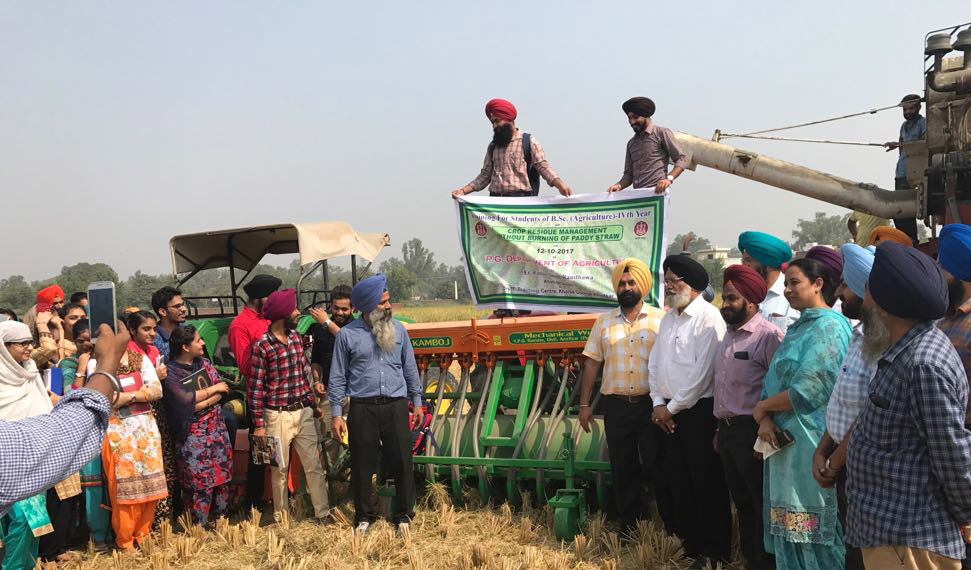
Union Agriculture Minister and Environment Minister chair a high-level meeting on stubble management under the Crop Residue Management (CRM) Scheme. A provision has been made for 2026–27 under the CRM scheme. The scheme addresses stubble burning in Punjab, Haryana, Uttar Pradesh, Madhya Pradesh, and NCT Delhi.
Crop Residue Management (CRM) Scheme under RKVY:
| Dimension | Key Details |
|---|---|
| Type | CRM scheme comprises a Centrally Sponsored Scheme, and it is not fully funded. |
| Launch and Parent Programme | CRM scheme has been launched in 2018, and it is implemented under Rashtriya Krishi Vikas Yojana (RKVY). |
| Nodal Ministry | The scheme is governed by the Ministry of Agriculture and Farmers Welfare. |
| Implementing Agency and Supervision | The scheme is implemented by State Agriculture Departments under the supervision of the Indian Council of Agricultural Research (ICAR). |
| Coverage (Geographical) | The scheme applies to Punjab, Haryana, Uttar Pradesh, Madhya Pradesh, and NCT Delhi. |
| Coverage (Institutions) | The scheme comprises ICAR institutions, Krishi Vigyan Kendras (KVK), and State Agricultural Universities (SAU). |
| Funding Pattern | Funds are shared 60:40 between the Centre and Punjab, Haryana, Uttar Pradesh, and Madhya Pradesh, while NCT Delhi receives 100% Central funding. |
| Subsidies | Subsidies are provided as follows: 50% subsidy for farmers for crop residue management machines; 80% subsidy for Custom Hiring Centres (CHCs); 65% subsidy for paddy straw supply chain projects. |
| Supply Chain Feature | Paddy straw is collected, baled, and linked to industries such as biomass power plants, thermal power plants (co-firing), bio-CNG units, and ethanol plants. |
| Awareness and Training | Information, Education and Communication (IEC) campaigns, technology demonstrations, and capacity-building programmes train farmers in Direct Seeded Rice (DSR), bio-decomposers, and CRM machinery. |
| Direct Seeded Rice (DSR) | DSR comprises sowing paddy seeds directly into the main field, eliminating labour-intensive nursery raising and manual transplantation into fields. |
| Monitoring and Enforcement | Monitoring comprises real-time monitoring of stubble burning incidents, geotagging of Custom Hiring Centres (CHCs), and deployment of a Stubble Protection Force in NCR districts. |
| In-situ Management | In-situ (on-site) management provides for retention, incorporation, mulching, and bio-decomposer use. |
| Ex-situ Management | Ex-situ (off-site) management provides for baling, transport, and industrial use in biomass power, bio-CNG, ethanol, and pellet units. |
| Target 2026–27 | Targets for 2026–27 comprise distributing 46,000 crop residue management machines, establishing 910 Custom Hiring Centres, and developing 141 supply chain projects linking farmers with straw-using industries. |