|
Aditya-L1 and ESA’s Proba-3 combine coronagraph data to study CMEs
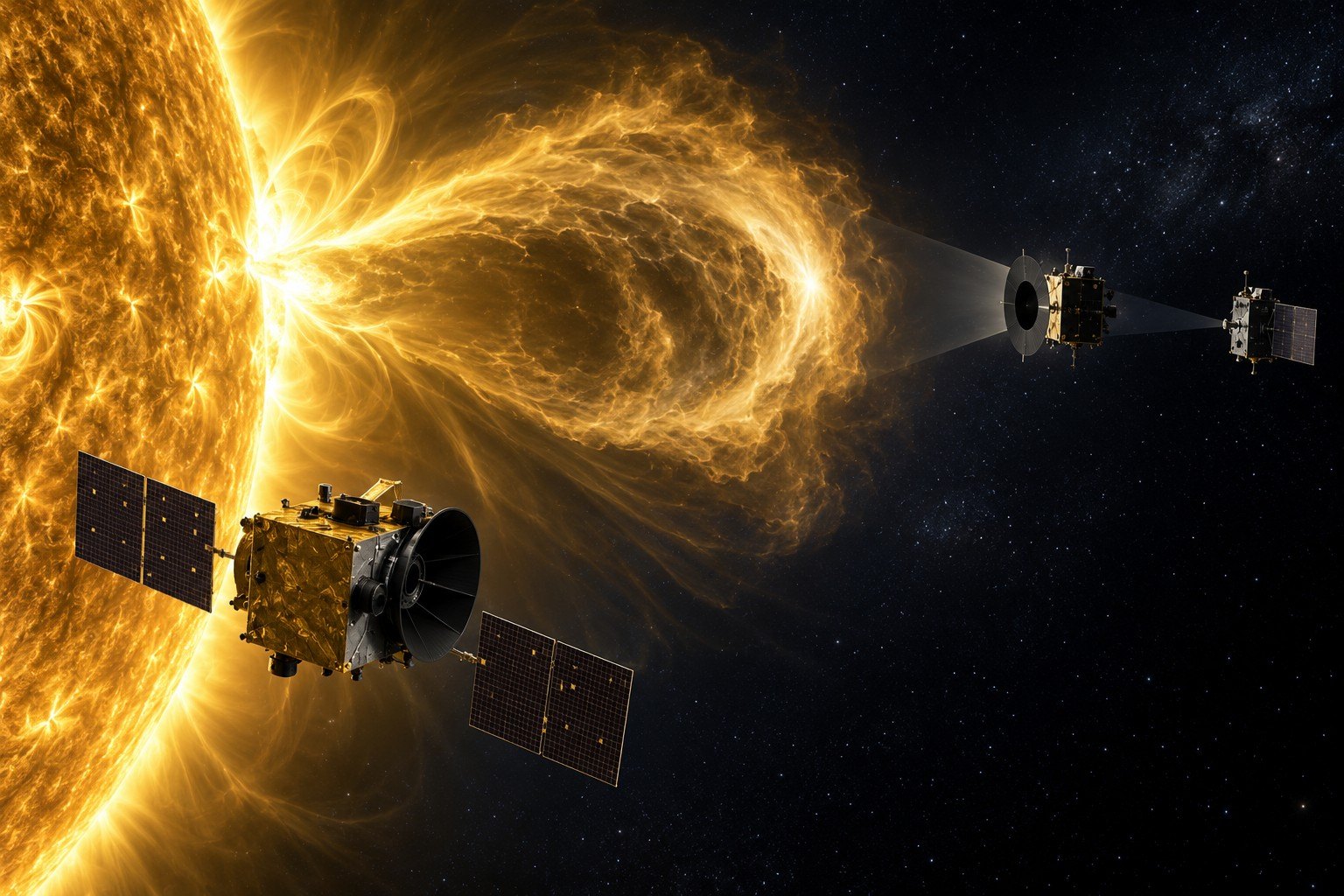
Scientists’ current study comprises analysis of solar eruptions and coronal mass ejections (CMEs) using data derived from India’s Aditya-L1 mission and Europe’s Proba-3 mission. Data sources comprise coronagraph observations from Aditya-L1 and ESA’s Proba-3 for study of 2 CMEs.
Aditya-L1 and ESA Proba-3 Coronagraph Data on CMEs:
| Dimension | Key Details |
|---|---|
| Aditya-L1 mission identity | Aditya-L1 comprises India’s first dedicated solar mission. |
| Aditya-L1 launch details | Aditya-L1 mission status comprises launch by PSLV-C57 on September 2, 2023. |
| Proba-3 mission identity | Proba-3 comprises a mission of the European Space Agency (ESA). |
| Proba-3 launch details | Proba-3 mission status comprises launch by PSLV-XL from Sriharikota on December 5, 2024. |
| Proba-3 spacecraft configuration | It comprises 2 spacecraft about 150 m apart, with one spacecraft’s shadow on the other. |
| Instruments used for observations | Observations comprise Visible Emission Line Coronagraph (VELC) aboard Aditya-L1 and ASPIICS coronagraph aboard Proba-3. |
| Observation purpose | Observation purpose comprises measurement of eruptions’ mass, density, and energy, providing new constraints on physical processes shaping them in the Sun’s inner corona. |
| CME definition | CMEs comprise large eruptions in which the Sun ejects vast quantities of magnetised plasma into space. |
| Earth-directed CME impacts | Earth-directed CMEs comprise disturbances to Earth’s space environment and effects on satellites and other space-based systems. |
| VELC capability | VELC comprises spectroscopy for study of the solar corona, including temperature and density of its gas. |
| ASPIICS capability | ASPIICS comprises corona imaging using visible light and a green emission line. |
| CMEs analysed in the study | The researchers’ dataset comprises 2 CMEs observed on September 14, 2025, and September 16, 2025. |
| September 14, 2025 CME speed | The September 14 CME comprises a relatively fast event travelling at about 645 km/s. |
| September 16, 2025 CME speed | The September 16 CME comprises a slower event moving at about 145 km/s. |
| Density and expansion | The slower CME comprises stronger early expansion with density decreasing more rapidly with height. |
| Energy distribution | The study results comprise differences in energy distribution among thermal, kinetic, and magnetic components in the 2 eruptions. |