|
Odisha Forest Department Rescues Five Baby Orangutans in Balasore
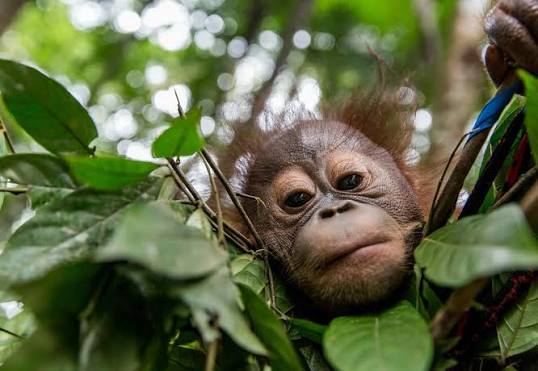
The Odisha Forest Department rescues 5 baby orangutans from a forest in Balasore district and shifts them to Nandankanan Zoological Park near Bhubaneswar. Their presence in India triggers suspicion of transnational wildlife smuggling and brings focus on CITES-linked procedures, including DNA-based origin confirmation and possible repatriation.
Orangutan, CITES, and Indian Legal Provisions:
| Dimension | Key Details |
|---|---|
| Age profile | The rescued orangutans comprise animals under 2 years of age. |
| Natural range | The natural range of orangutans comprises the rainforests of Indonesia and Malaysia only. |
| Living orangutan species | Three living orangutan species comprise Bornean, Sumatran, and Tapanuli. |
| Island distribution | All three living orangutan species are found only on the islands of Borneo and Sumatra. |
| CITES listing | All three living orangutan species are listed under CITES Appendix I. |
| Species confirmation | Physical characteristics raise suspicion of Sumatran origin, and species and genetic origin confirmation mandates DNA testing. |
| CITES legal status and system | CITES regulates international wildlife trade through a licensing system controlling import, export, and re-export of live animals, plants, body parts, and trophies. |
| CITES timeline | CITES has come into effect in 1975, and as a party, it applies to India from 1976. |
| CITES coverage numbers | CITES protects around 6,700 animal species, including 339 mammals, 159 birds, 113 reptiles, 24 amphibians, 26 fish, and 69 invertebrates. |
| CITES appendices | CITES comprises 3 Appendices that list species according to the level of protection. |
| CITES Appendix I (trade rule) | Appendix I covers species threatened with extinction, and trade is generally prohibited and allowed only in exceptional, non-commercial cases such as research, transfers between recognised zoos, and breeding programmes. |
| Appendix I captive-bred rule | Captive-bred Appendix I species may be traded with valid permits for conservation purposes. |
| CITES Appendix II | Appendix II species face strict controls. |
| CITES listing updates | Listings are updated at Conferences of Parties. |
| Indian law alignment with CITES | India’s Wild Life (Protection) Act, 1972 is amended in 2022 to harmonise it with CITES by adding a Schedule of CITES-listed species. |
| Section 49Q (scope) | Section 49Q provides for specific mechanisms for living CITES-listed animals. |
| Section 49Q (illegal import determination) | As per Section 49Q, authorities must first establish that living CITES-listed animals are illegally imported. |
| Appendix I legal import documentation | Legal import of an Appendix I species requires CITES import documentation and valid export or re-export papers from the exporting country. |
| Section 49Q (repatriation condition and cost) | If repatriation is feasible, the animals are returned to the country of origin at that country’s expense. |
| Section 49Q (if return is not feasible) | If return is not feasible, the animals must be housed and cared for at a recognised zoo or rescue centre. |
| CITES repatriation consultation | CITES recommends that the management authority, which comprises the Environment Ministry in India, consult scientific authorities and, where possible, the state of origin before deciding on repatriation. |
| CITES position on return to the wild | The treaty does not make return to the wild obligatory. |
| CITES requirement on recipient states | CITES mandates that the confiscating authority ensure recipient states understand the impacts of repatriation. |
| Indonesia support | Indonesia’s Ministry of Forestry offers support and is preparing technical requirements for repatriation if investigations confirm Indonesian origin. |
| Odisha officials’ position | Odisha officials stress that Indonesia’s offer does not establish ownership. |
| India’s completed initial steps | India has completed initial steps comprising securing the animals, veterinary care, and quarantine. |
| DNA analysis status | DNA analysis is the next step, and Indonesia’s request cannot be acted upon until origin is confirmed. |
| Assam precedent | In 2022, 2 baby orangutans are found in a cardboard box at the Lailapur checkpost near the Assam-Mizoram border. |
| Assam case (identity and confirmation) | Named Panoi and Jonki, the 2 orangutans are confirmed as Sumatran orangutans by the Central Zoo Authority’s inventory and remain at the Assam State Zoo. |
| Assam case (repatriation constraint as stated) | The 2 orangutans could not be returned because the investigation into the smuggling network stalled. |
| DGCA guidelines | Under July 2025 DGCA guidelines, airlines must immediately send back illegally transported live animals. |
| Smuggling routes | A July 2026 report by Humane World for Animals India comprises two main smuggling routes: overland through Northeast India’s borders with Bangladesh and Myanmar, and by air via Chennai, Bengaluru, and Mumbai airports. |
| Seizure data | In May 2022, 468 animals of 6 to 7 species are seized in Mizoram’s Champhai district. |
| Modus operandi | Wild-caught animals are laundered as captive-bred with fake paperwork. |
| World Wildlife Crime Report | As per the 2024 World Wildlife Crime Report, the trade comprises links to narcotics networks. |
| Voluntary disclosure scheme | A 2021 voluntary disclosure scheme draws 43,693 amnesty applications from 30 states and UTs, including lemurs, kangaroos, rhinoceroses, and iguanas. |
| Official data status | The 2021 voluntary disclosure scheme remains the only official data on exotic species in India. |