|
MIT-led MoM survey spots early-universe black hole
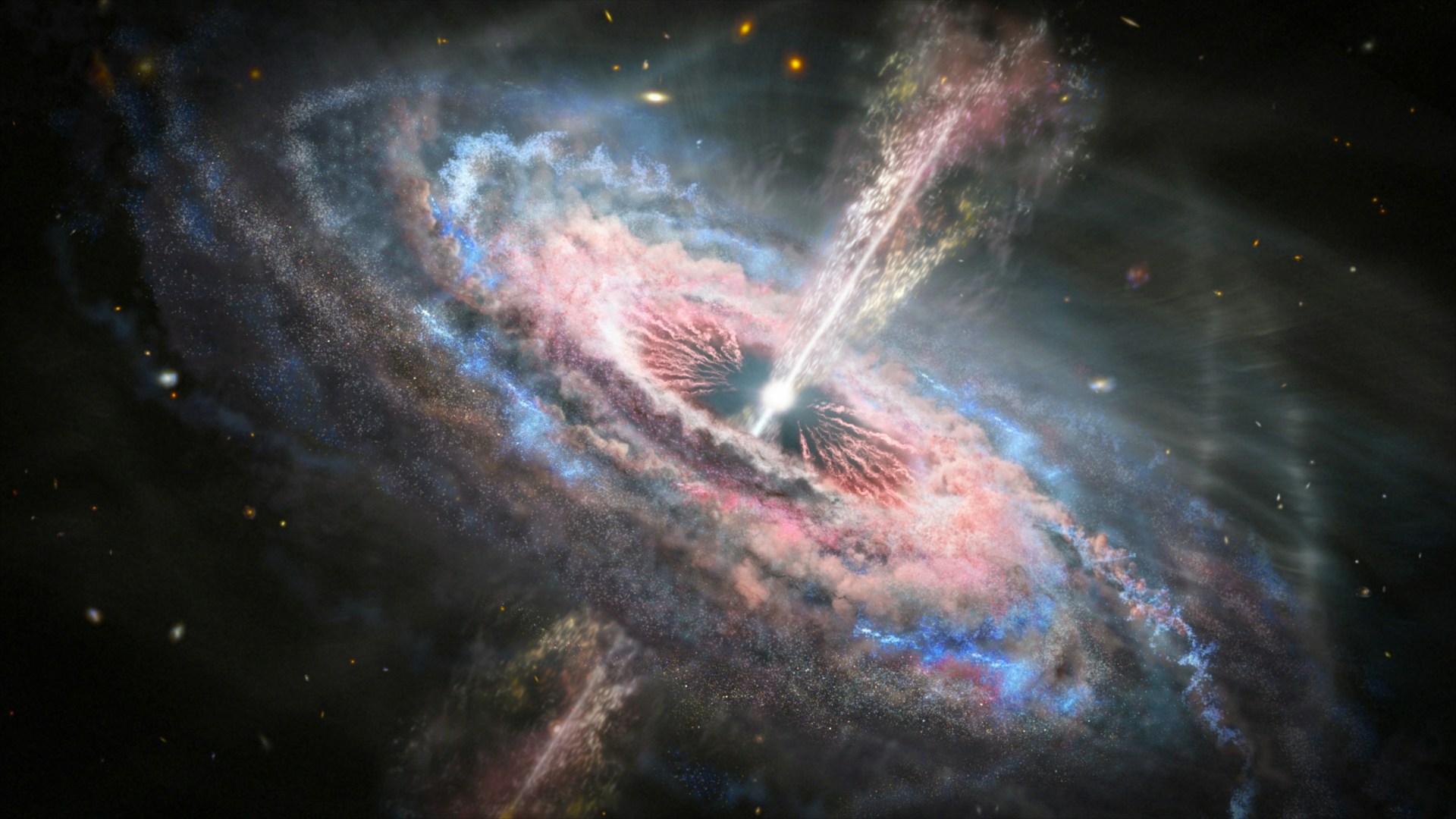
Astronomers led by MIT researchers, during the Mirage or Miracle (MoM) survey, identify an early-universe object designated MoM-BH-1*. The object exists just 660 million years after the Big Bang and is reported as a “naked” template linked to JWST-observed “little red dots” (LRDs).
MoM-BH-1* (Early-universe black hole candidate):
| Dimension | Key Details |
|---|---|
| Initial appearance | At first glance, it resembles an enormous star roughly the size of the solar system. |
| Luminosity observation | It shines 100 billion times brighter than any normal star could physically generate through nuclear fusion. |
| Internal structure | It comprises a central supermassive black hole, wrapped inside an ultra-dense, turbulent cocoon of hydrogen gas. |
| Black hole mass (reported range) | The central black hole is roughly 100,000 to 1 million solar masses. |
| Gas vs. dust reddening (assumption vs. finding) | Astronomers typically assume deeply reddened objects are obscured by heavy cosmic dust, but modeling reveals the object contains very little dust. |
| Spectral anomaly | It displays an exceptionally deep Balmer break, along with unique hydrogen absorption features that rule out ordinary stellar populations. |
| Mechanism behind red, compact appearance | The extreme density of surrounding hydrogen gas absorbs, scatters, and re-emits radiation from the central black hole, creating a deep red, compact appearance without requiring large amounts of dust. |
| JWST linkage | Since its launch, JWST has imaged mysterious, compact “little red dots” (LRDs) in the early universe. |
| Inference using MoM-BH-1* | Because its emission completely outshines its host galaxy, it confirms that LRDs are likely growing black holes encased in dense gas cocoons rather than dust-heavy galaxies. |