|
India Grants Legal Recognition to E100 Fuel, Enabling Flex-Fuel Vehicles (E20–E100)
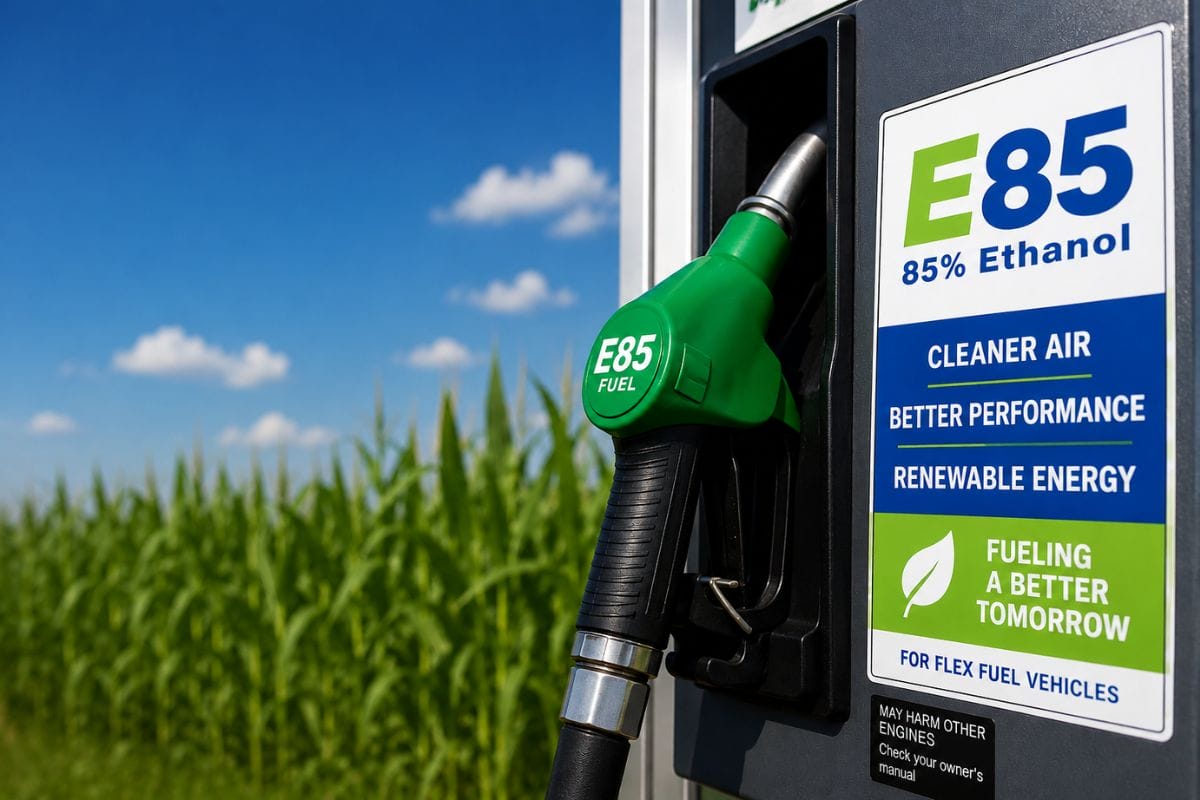
India grants legal recognition to E100 fuel, enabling the launch of flex-fuel vehicles by companies. Flex-fuel vehicles operate on ethanol blends from E20 to E100, without restricting consumers to a single blend.
E100 Fuel, Flex-Fuel Vehicles, and Ethanol Blending (India):
| Dimension | Key Details |
|---|---|
| Flex-fuel vehicles (FFVs) | FFVs are capable of operating on ethanol blends from E20 to E100, without restricting consumers to a single blend. |
| Ethanol blending | Ethanol blending refers to the process of mixing ethanol with petrol to create a more sustainable and cleaner burning fuel. |
| Types of ethanol blends (by volume) | Types comprise E10 (10% ethanol), E20 (20% ethanol), E85 (80–85% ethanol), and E100. |
| India target (E20) | India’s target provides for 20% ethanol blending (E20) in petrol by 2025–26 under the Ethanol Blended Petrol (EBP) Programme and National Policy on Biofuels, 2018 amended in 2022. |
| Recent achievement | E20 target has been achieved in 2025, 5 years ahead of the initial schedule. |
| E85 rollout | E85 has been rolled out across several retail outlets of Public Sector OMCs. |
| Foreign exchange savings (EBP) | EBP program saved India ₹1.84 lakh crore in foreign exchange since ESY 2014–15. |
| Ethanol feedstocks mentioned | Ethanol production comprises sugarcane, maize, damaged food grains, and agricultural residues. |
| GHG emissions (E85 in FFVs) | FFVs operating on E85 can reduce lifecycle greenhouse gas emissions by around 61% compared to conventional petrol vehicles. |
| Particulate matter emissions | Higher ethanol blends promote more complete combustion, resulting in near-zero particulate matter emissions. |
| Octane rating of ethanol | Ethanol provides an octane rating of 100–105. |
| Price example (E85) | E85 is priced nearly ₹20 per litre lower than conventional petrol. |