|
Elias 2-24 b Confirmed as Youngest Known Exoplanet
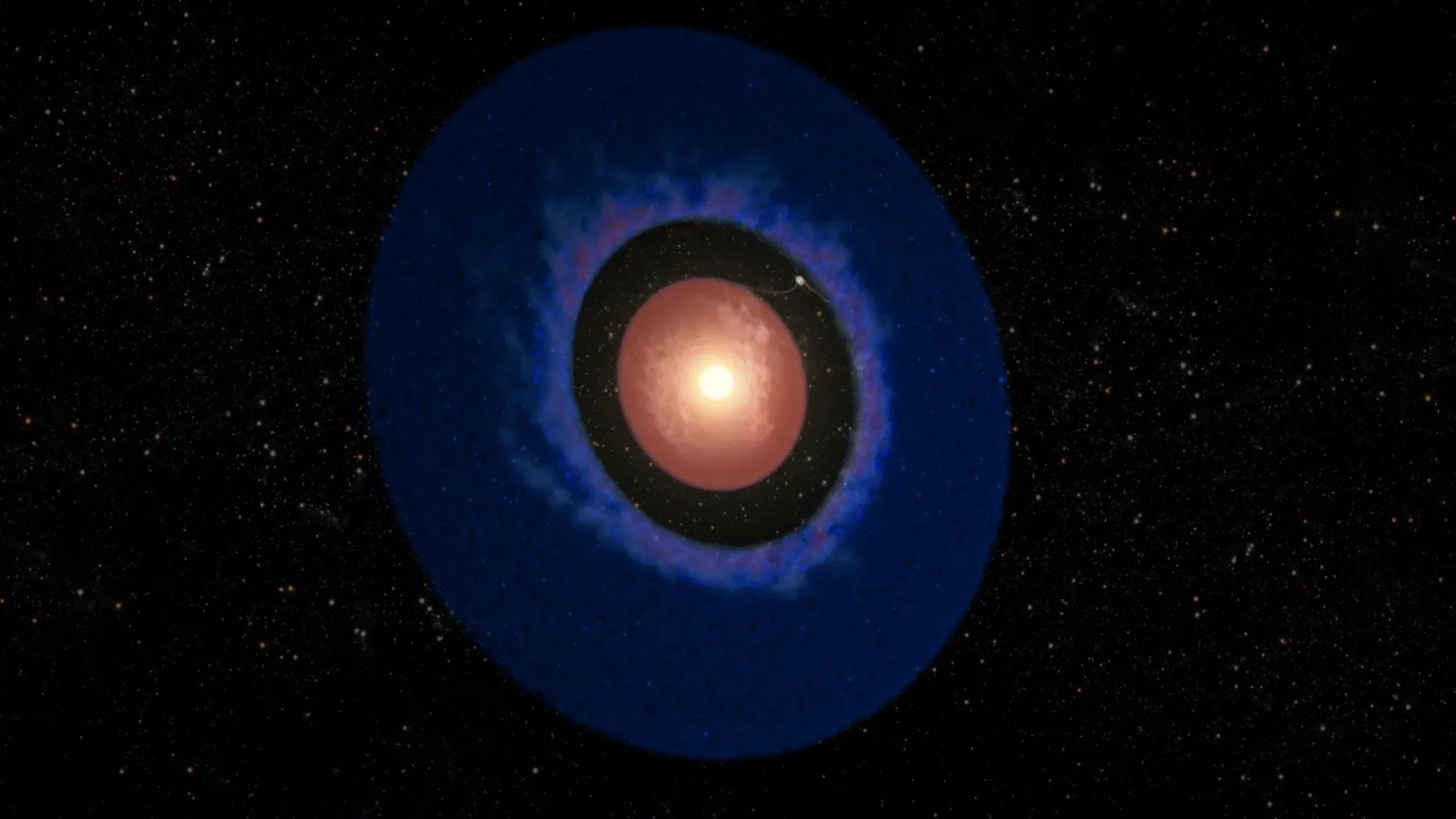
Astronomers confirm Elias 2-24 b as the youngest known exoplanet after re-examining archival Keck Observatory observations. The host star lies in the ρ Ophiuchi star-forming region, and the object’s motion matches a planet rather than a background star or imaging artifact.
Elias 2-24 b:
| Dimension | Key Details |
|---|---|
| Location of host star | The host star lies in the ρ Ophiuchi star-forming region, a nearby stellar nursery. |
| Distance from Earth | The planet sits about 450 light-years from Earth. |
| Size | The planet is roughly Jupiter-sized. |
| Formation environment | The planet is still embedded in the gas and dust where it formed. |
| Age inference | The authors infer the planet is under a million years old, but assume 1 million years to model its size. |
| Earlier record holders | The earlier record holders comprise a four-way tie: 2 planets around PDS 70, and 2 in the WISPIT 2 system, and all are more than 5 million years old. |
| Distance from its star | The planet orbits roughly 55 times farther out than Earth does from the Sun. |
| Mass estimates | Most reports say it is about Jupiter's mass, and the authors’ modelling puts it at 2 to 14 times Jupiter, with the exact figure uncertain. |
| Reason for mass uncertainty | The exact mass figure is uncertain because the planet is still growing inside a thick cloud of gas and dust. |
| ALMA observation | Atacama Large Millimeter/submillimeter Array (ALMA) in Chile first reveals a gap in the disk around Elias 2-24. |
| VLT observation | The European Southern Observatory's Very Large Telescope spots a light source within the gap. |
| Keck archival data used for confirmation | Bernardi's team re-examines Keck Observatory observations from 2018 and 2020 and finds the object’s motion matches a planet rather than a background star or imaging artifact. |
| Debate duration | Astronomers argue for about 10 years over whether the object is a planet. |
| Coronagraph technique | A coronagraph blocks a star's glare so light from orbiting planets can be seen directly. |
| Target selection in coronagraph search | The team searches coronagraph data for 7 stars with debris disks, expecting a planet in a gap, and finds one. |
| Multi-telescope effort | The confirmation uses several telescopes together: ALMA, VLT, and Keck. |