|
Indian Army to Deploy Six AASHVAST Labs
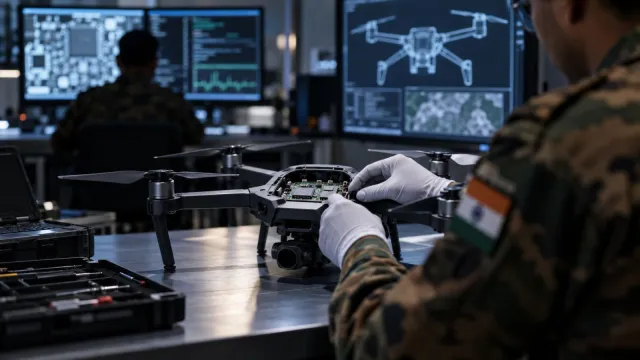
Indian Army authorises deployment of 6 AASHVAST labs nationwide and mandates cybersecurity screening for drones and CCTV systems. The AASHVAST labs provide for testing and validation of military electronics for hidden security weaknesses and security threats.
AASHVAST Lab:
| Dimension | Key Details |
|---|---|
| Full form | AASHVAST comprises “Assessment and Analysis of Electronic Systems Hardware for Vulnerabilities and Security Threats.” |
| Primary goal | The system provides for verification that critical military systems operate as intended and comprise no unauthorized components or malicious code. |
| Developer and sponsoring authority | The system comprises development by a private firm for the Directorate General of Electronics and Mechanical Engineering (DG EME). |
| Vulnerability coverage | The labs comprise detection coverage of approximately 14 types of vulnerabilities. |
| Equipment covered | The facility comprises hardware and software scrutiny for drones, communication systems, sensors, and other defence equipment. |
| UAV software layer | The facility comprises scrutiny of UAV-operating software for firmware-level vulnerabilities. |
| Location-based security controls | The system comprises assessment of location-based security controls, including response to GPS spoofing or jamming by an adversary. |
| Threat vectors covered | The system comprises scanning for hidden passwords, embedded keys, and remote-access tools. |
| Software update control | The system comprises validation that a drone accepts only manufacturer-approved software updates. |
| Operational threat handling | The facility provides for neutralisation of common threats of enemy interference in Indian drones in a contested area. |