|
Device Divide in India
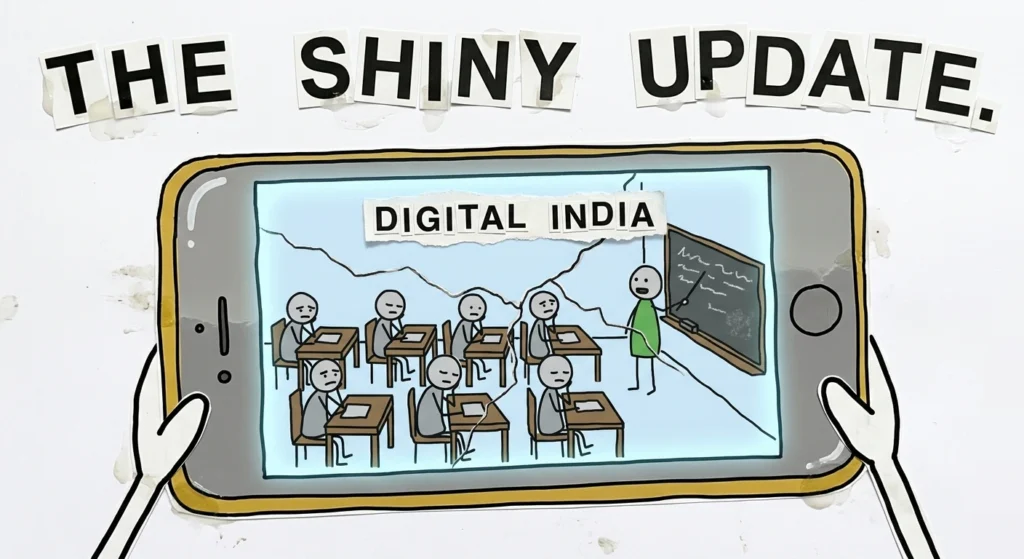
The “Evolving Landscape of Digital Inclusion in India” report by the National Council of Applied Economic Research (NCAER) highlights multiple overlapping digital divides in India despite the internet user base surpassing 1 billion by 2025.
“Evolving Landscape of Digital Inclusion in India” Report (NCAER):
| Dimension | Key Details |
|---|---|
| Report and authority | The “Evolving Landscape of Digital Inclusion in India” report is brought out by the National Council of Applied Economic Research (NCAER). |
| Internet user base | India’s internet user base surpasses 1 billion by 2025, as per the report. |
| Device divide | 95% of households own a mobile phone, and 8% of households own a computer or laptop. |
| Connectivity gap (offline households) | 27.5% of Indian households remain entirely offline, with 32.2% in rural areas and 17.2% in urban areas. |
| Usage skew | Internet engagement is driven by entertainment (66%) and social media (53.8%), with uptake for education (16.1%) and government services (11.4%). |
| Dependency factor | 20.4% of households require outside help to navigate digital services. |
| Gender gap | 35.6% of working-age women use the internet, compared to 57.6% of men. |
| Age-based exclusion | 9.4% of the elderly (60+) participate online. |
| Connectivity quality | Provides for expanding affordable broadband and public Wi-Fi to bring the offline population online and enable higher-order use cases beyond mobile entertainment. |
| Next-generation investment | Provides for integrating digital literacy into school curricula and focusing on maternal and paternal education to break the intergenerational transmission of digital inequality. |
| Assistance to older adults | Provides for expanding community-based, assisted digital service centers, and designing age-friendly, vernacular interfaces to ensure the elderly are not excluded from welfare benefits. |
| Closing the gender gap | Provides for moving beyond household-level access to measure and address intra-household inequalities, ensuring women from all socio-economic backgrounds have independent access and use. |