|
USTR Probes EU’s Carbon Border Adjustment Mechanism Expansion
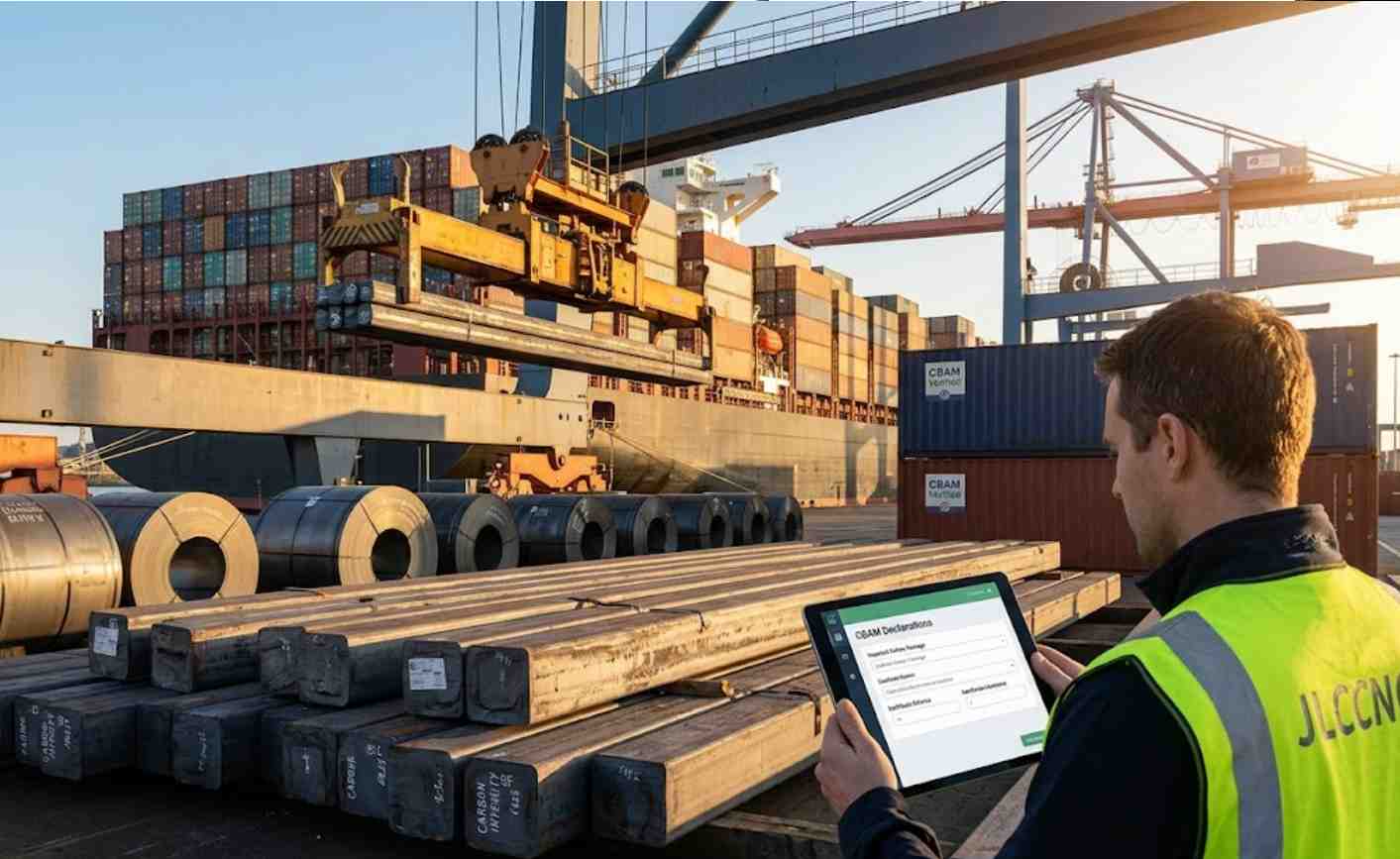
The United States Trade Representative (USTR) launches an investigation into the European Union’s expansion of the Carbon Border Adjustment Mechanism (CBAM). The USTR invites public comments from American small businesses till November 9, signalling possible retaliation and pressure on the EU to soften CBAM implementation. The development is linked to an India-EU trade deal clause that extends EU CBAM concessions given to other partners to India.
Carbon Border Adjustment Mechanism:
| Dimension | Key Details |
|---|---|
| CBAM definition | CBAM comprises the EU’s carbon pricing mechanism. |
| Core requirement on EU importers | CBAM mandates EU importers in 6 carbon-intensive sectors to declare embedded emissions of imported products and pay a carbon price equivalent to what EU domestic producers pay. |
| Covered sectors | CBAM applies to 6 sectors: aluminium, cement, electricity, fertiliser, hydrogen, and iron and steel. |
| Default emission values | The EU calculates default emission values using country-level and sector-level production and energy data. |
| Punitive mark-up on default values | The EU adds a punitive mark-up to default emission values to push companies toward submitting verified company-level data. |
| Verification requirement | Company-level data under CBAM mandates verification by an EU-accredited third-party verifier. |
| USTR’s stated concern | The verification requirement is stated to add cost and compliance burden that disproportionately hurts American small businesses. |
| India-EU trade deal clause | The India-EU trade deal comprises a ‘forward-Most Favoured Nation’ (MFN) CBAM clause that provides for automatic extension to India of any CBAM concession the EU grants another trading partner under a separate agreement. |
| EU-US joint statement | In an EU-US trade deal joint statement (August last year), the European Commission commits to work to provide additional flexibilities in CBAM implementation for US businesses. |
| Estimated impact on select Indian exports | According to the Global Trade Research Initiative (GTRI), CBAM could translate into a 20-35% tax on select Indian exports, particularly iron, steel, and aluminium, into the EU. |
| Steel-scrap related issue | The EU’s move to curb steel-scrap exports, combined with CBAM, acts as a non-tariff barrier against Indian industry. |
| Emissions intensity by steelmaking route | Steelmaking routes comprise: blast furnace-basic oxygen furnace (BF-BOF) as highest emissions; gas-based direct reduced iron (DRI) as lower emissions; scrap-based electric arc furnace (EAF) as lowest emissions. |
| India’s vulnerability | Indian manufacturers largely rely on the blast furnace route, making them currently underprepared for CBAM’s carbon-price burden. |
| Government initiative | The government plans to scale up scrap-based steel production via electric arc furnace technology, under its Green Steel Initiative. |
| ICRIER report finding | A May 2025 report by the Indian Council for Research on International Economic Relations (ICRIER) flags that scrap makes up only 20% of India’s steelmaking feedstock, limited by domestic scrap availability of ~25 Million Metric Tonnes (MMt) annually. |