|
Third BIMSTEC Conference begins in Goa
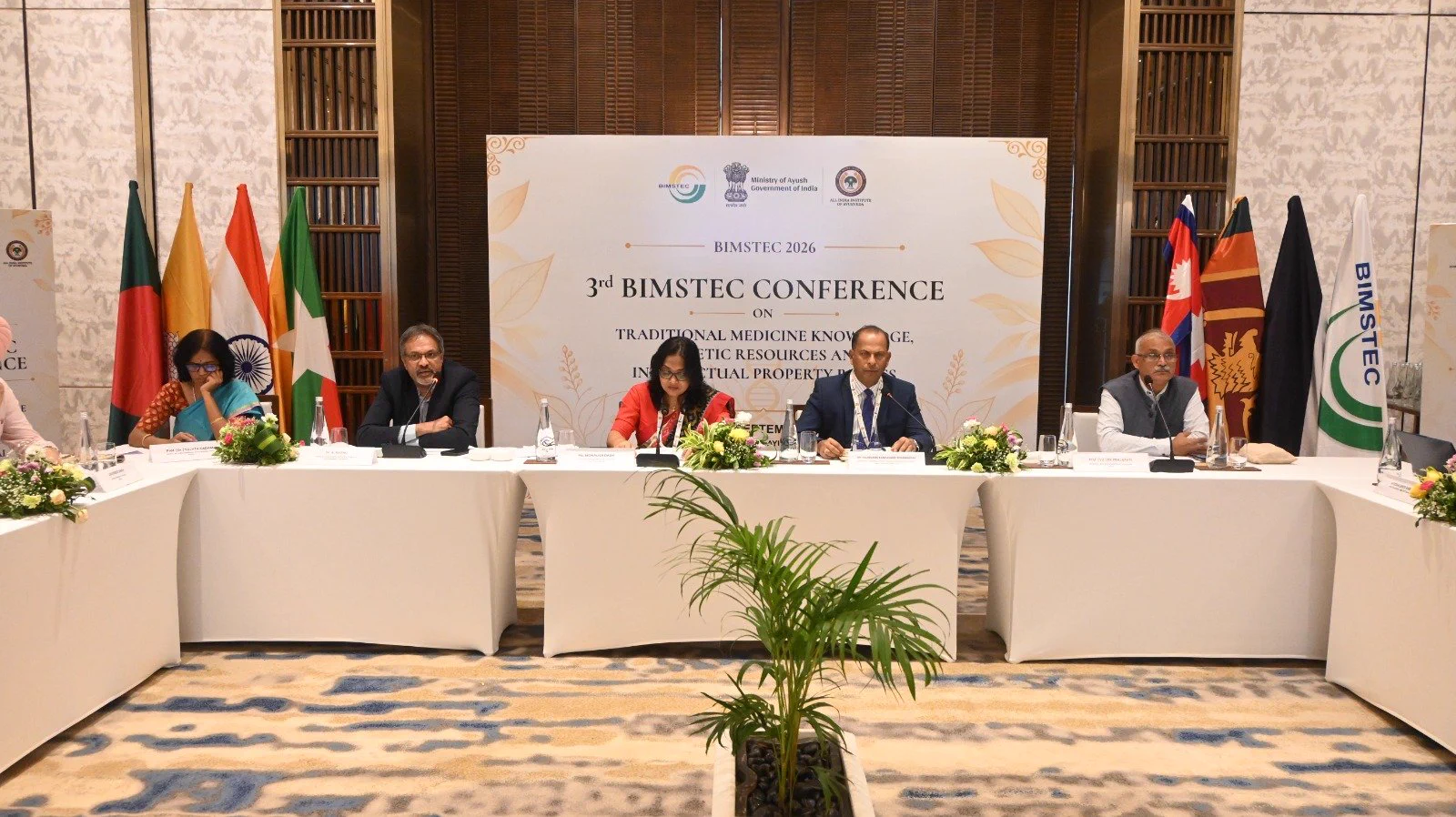
The Third BIMSTEC Conference on Traditional Medicine Knowledge, Genetic Resources and Intellectual Property Rights begins in Goa with focus on conservation and benefit-sharing. The Ministry of Ayush organises the event, with the All-India Institute of Ayurveda (AIIA), Goa serving as the nodal institute.
The Third BIMSTEC Conference:
| Dimension | Key Details |
|---|---|
| Parallel meeting | Is held alongside the 2nd Meeting of the BIMSTEC Nodal Group on Traditional Medicine Knowledge, Genetic Resources and Intellectual Property Rights. |
| Participants | Comprises representatives from BIMSTEC member countries: Bangladesh, Bhutan, India, Myanmar, Nepal, Sri Lanka, and Thailand. |
| What participants share | Representatives share their respective national policies, legal frameworks, and experiences. |
| Objective: collaborative framework | Authorises development of a collaborative framework that promotes conservation of traditional knowledge while encouraging legitimate research and innovation. |
| Objective: community safeguards | Mandates safeguarding community interests through prior informed consent, mutually agreed terms, and equitable benefit-sharing. |
| BIMSTEC origin and initial name | Provides for a sub-regional grouping formed on 6 June 1997 in Bangkok under the name BIST-EC (Bangladesh, India, Sri Lanka, and Thailand Economic Cooperation). |
| Renaming after Myanmar inclusion | Provides for inclusion of Myanmar in 1997 during a special Ministerial Meeting in Bangkok, after which the group is renamed BIMST-EC (Bangladesh, India, Myanmar, Sri Lanka and Thailand Economic Cooperation). |
| Nepal status changes | Provides for Nepal to become an observer in 1998, and Nepal to become a full member in February 2004. |
| Bhutan membership | Provides for Bhutan to become a full member in February 2004. |
| Leadership rotation | Provides for leadership to be rotated in alphabetical order of country names. |
| Permanent secretariat | Provides for a permanent secretariat in Dhaka, Bangladesh. |
| Bridge role | Serves as a strategic regional bridge connecting South Asia and Southeast Asia, and acts as a strategic geographic and economic bridge connecting the regional blocs of SAARC and ASEAN. |