|
Sagarmala Finance Corporation Plans India’s First Blue Bond Issue
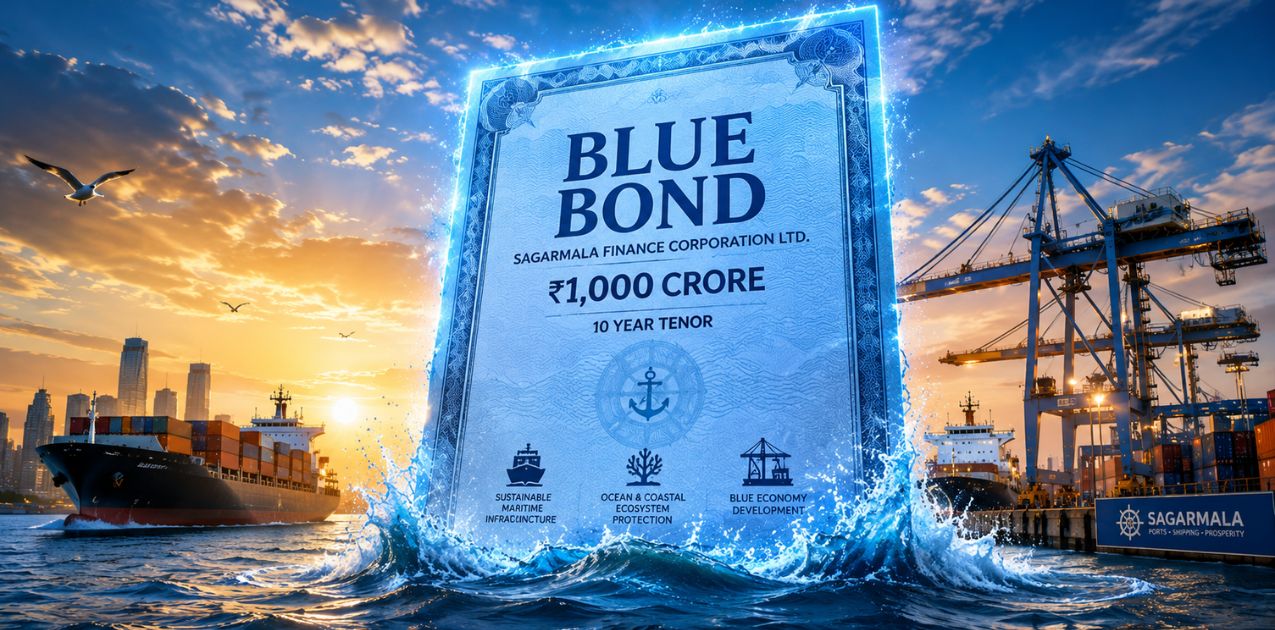
Sagarmala Finance Corporation Ltd. (SMFCL), the financing arm associated with the Sagarmala programme under PM GatiShakti, is planning India’s first blue bond issue. SMFCL is slated to raise as much as ₹1,000 crore through the issuance, and SEBI recognises blue bonds as part of sustainable finance instruments.
Blue Bond:
| Dimension | Key Details |
|---|---|
| Blue bond definition | A blue bond provides for money being raised from investors with periodic interest and repayment of principal at maturity, and proceeds must go towards clearly identified water- and ocean-related projects. |
| Issuer requirements | Key requirements for issuers comprise: a framework explaining where the money will be invested, impact measurement mechanisms, and periodic reporting to avoid “bluewashing.” |
| Greenwashing definition | Greenwashing provides for the deceptive practice of making a product, service, or company appear more environmentally friendly than it actually is. |
| Regulatory recognition | SEBI has recognised blue bonds as part of sustainable finance instruments and highlighted their potential for India’s blue economy. |
| Use-of-proceeds restriction | Blue bond financing applies only to Sagarmala projects demonstrating measurable ocean or water-related sustainability outcomes. |
| SMFCL financing rationale | SMFCL’s infrastructure loans span around 12 years, while its existing borrowing tenure is shorter, and a longer-duration bond provides for maturity matching and borrowing diversification. |
| Investor categories | A longer-duration bond provides for attracting investors such as insurance companies, pension funds, and global sustainability-focused funds. |
| Sagarmala project scale | The proposed ₹1,000 crore issuance represents 0.17% of Sagarmala’s total identified project cost of over ₹6 lakh crore. |
| Sagarmala projects identified | Sagarmala has identified over 200 projects under coastal shipping and inland water transport. |
| Beneficiary segments | Key beneficiary segments comprise: Ro-Ro and Ro-Pax ferry services, inland water terminals, coastal cargo movement, and cruise infrastructure including terminals at Mumbai, Kochi, and Chennai. |
| Largest investment segment under Sagarmala | Port modernisation comprises the largest investment segment under Sagarmala, worth nearly ₹2.9 lakh crore. |
| Global issuance | According to the World Bank, cumulative blue bond issuance has crossed $15 billion by mid-2025, up from about $222 million in 2018. |
| Selected global blue bond transactions | Examples mentioned comprise: October 2018 Seychelles, with World Bank support, issuing the world’s first sovereign blue bond; 2019 Nordic Investment Bank issuing an early institutional blue bond; 2021 Belize restructuring about $553 million of external debt with support from The Nature Conservancy. |
| Regional pattern | Asia-Pacific accounts for the largest share of cumulative blue and water-labelled bonds. |
| Constraints | Structural challenges comprise: no universally accepted “blue taxonomy,” valuation difficulty for outcomes such as coral restoration and biodiversity improvement, narrow investor base, and project readiness gap. |
| India: coastline and trade share | India has a coastline of about 7,500 km, and around 95% of trade by volume moves through maritime routes. |