|
RBI Governor Flags Complacency Risks Despite Stable Financial System
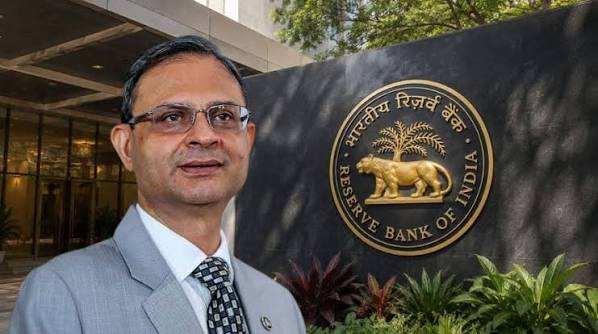
RBI Governor Sanjay Malhotra calls for continued vigilance to protect financial stability, stating that India’s financial system shows no imminent signs of stress while warning against complacency. He flags that prolonged stability can encourage higher risk-taking and leverage, allowing vulnerabilities to accumulate across the financial system.
Financial Stability:
| Dimension | Key Details |
|---|---|
| Definition | Financial stability refers to the ability of the financial system to continue functioning effectively despite economic or financial shocks. |
| Coverage | The financial system comprises banks, non-banking financial companies (NBFCs), financial markets, payment systems, and supporting infrastructure. |
| Current assessment | India’s financial system currently shows no imminent signs of stress. |
| Complacency risk | Prolonged stability can encourage risk-taking and let vulnerabilities accumulate. |
| Risk build-up channel | As memories of earlier crises fade, financial institutions, businesses, and investors may increase risk-taking and leverage. |
| Illustration from India’s experience | India’s experience with the legacy of excessive lending and non-performing assets (NPAs) from the early 2000s illustrates that financial stress can take years to resolve once vulnerabilities become systemic. |
| Priority 1: Strengthening systemic resilience | Strengthening systemic resilience provides for building a financial system capable of absorbing and containing shocks, including endogenous and exogenous shocks. |
| System resilience requirements | Resilience requires resilient institutions, credible safety nets, effective resolution mechanisms, and proportionate but forward-looking regulation and supervision. |
| Priority 2: Identifying new systemic risks | Potential triggers include geopolitical conflicts, cyberattacks, technological failures, supply-chain disruptions, financial-market shocks, and climate-related disruptions. |
| Risk interaction and assessment | Understanding dependencies and contagion channels is essential, with scenario analysis becoming an important component of risk management. |
| Priority 3: Better and more granular data | Effective risk monitoring depends on high-quality data as financial systems become increasingly interconnected and complex. |
| Data gaps flagged by RBI Governor | Data gaps relate to NBFIs, interconnected exposures, technology dependencies, and cross-border financial positions. |
| Use of granular data | Better and more granular data can help regulators identify vulnerabilities earlier, conduct stress testing, and understand shock transmission across institutions and markets. |
| Priority 4: System-wide resilience | A strong banking system alone is insufficient to guarantee financial stability. |
| System-wide resilience coverage | Resilience needs to extend across NBFIs, financial markets, payment systems, technology infrastructure, critical third-party service providers, and cross-border financial networks. |
| Interconnectedness channel | A disruption in one part of the financial system can spread through lending relationships, payment systems, technology providers, or common exposures. |
| Priority 5: Innovation without eroding trust | Financial innovation can improve efficiency and expand access to financial services. |
| Technologies | Technologies include Artificial Intelligence (AI), tokenisation, and new forms of financial intermediation. |
| Trust foundations | Foundations of trust comprise sound institutions, settlement finality, singleness of money, and financial integrity. |
| Objective for innovation | The approach provides for ensuring technological development does not create new vulnerabilities faster than regulatory and institutional safeguards can adapt. |
| Emerging global risks highlighted | Emerging global risks comprise geopolitical and geoeconomic fragmentation, strategic realignment, trade restrictions, repeated supply shocks, technological disruption, and climate change. |
| West Asia conflict observation | The West Asia conflict creates supply-side pressures, and India’s financial system is able to absorb the shock relatively well. |
| Financial stability and macro variables | Developments can simultaneously influence inflation, exchange rates, capital flows, and financial-market stability. |
| AI investment cycle concern | A slowdown in the global AI investment cycle can trigger correction in AI-related valuations and sharp repricing of financial assets where risk appetite and leverage push valuations upward. |
| AI leverage-risk linkage | If earnings and cash flows of major AI companies weaken while leverage remains elevated, financial-market corrections can become more pronounced. |
| Foreign investor behaviour | Foreign investors have continued to withdraw from Indian financial markets despite an improvement in recent net FDI flows. |
| Net FDI (2026-27, first 4 months) | Net FDI during the first 4 months of 2026-27 stands at $13.43 billion, 38% higher than the corresponding period of the previous year. |
| Net FDI (2024-25 and 2025-26 combined) | Net FDI for 2024-25 and 2025-26 together amounts to $7.7 billion. |
| Foreign investor sales (2026-27) | Foreign investors have sold Indian stocks and bonds worth $10.35 billion in 2026-27. |
| Foreign investor sales (2025-26) | Foreign investors have sold Indian stocks and bonds worth $16.59 billion during 2025-26. |
| Implication for resilience | These movements illustrate the importance of maintaining resilience against volatile international capital flows. |