|
Nepal’s Rasuwa Flash Flood on Nepal-Tibet Border
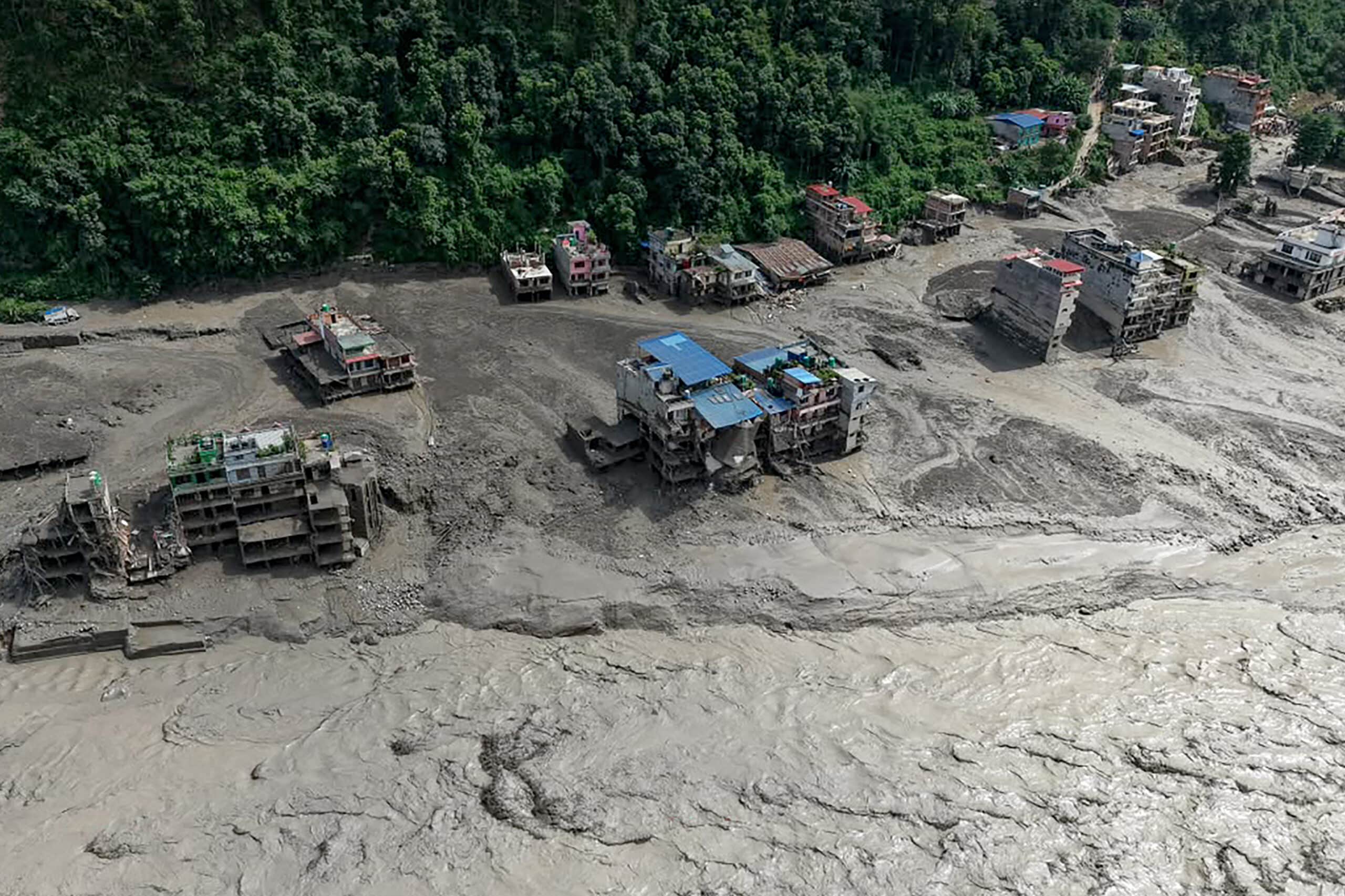
A catastrophic high-altitude flash flood strikes Nepal’s Rasuwa district along the Nepal-Tibet border, with floodwaters originating from upstream in Tibet and moving through the Lhende Khola, Bhote Koshi, and Trishuli River corridors. ICIMOD assessments indicate that a high-altitude ice and rock avalanche in Tibet collapses into the Lhende Khola, temporarily impounding water that breaches rapidly and releases a high-velocity surge downstream.
Nepal Rasuwa Flash Flood:
| Dimension | Key Details |
|---|---|
| Immediate physical mechanism | Avalanche debris temporarily impounds water in a narrow valley section, and the natural barrier breaches rapidly, releasing a massive, high-velocity surge of water, sediment, and boulders downstream. |
| Triggering events | Extreme events are triggered by thermal and structural instabilities in frozen water environments, including Glacier Lake Outburst Floods (GLOFs), permafrost degradation, and high-altitude ice-rock avalanches. |
| Cascading disaster phenomenon | The cascading disaster phenomenon occurs when a primary cryospheric trigger, such as an avalanche, creates secondary hazards, such as landslide dam impoundment, leading to tertiary impacts, including catastrophic downstream flooding and infrastructure failure. |
| Hydropower and transmission assets damaged | The flood damages at least 6 major hydropower and transmission assets, including the 111 MW Rasuwagadhi, 78 MW Sanjen Khola, and 60 MW Upper Trishuli 3A projects. |
| Power capacity disrupted | The damage disrupts nearly 430 MW, around 12% of Nepal's total installed power capacity. |
| Trade and connectivity impact | The flood severely damages the Rasuwagadhi-Gyirong customs checkpoint and key bridges, halts Nepal-China overland trade, and prompts heightened flood alerts along the lower Narayani (Gandak) and Koshi river basins in northern India. |
| Lhende Khola | Lhende Khola is a high-altitude transboundary stream on the Nepal-Tibet border where the avalanche impoundment occurs, and it is a key tributary of the Bhote Koshi. |
| Bhote Koshi River | Bhote Koshi is a transboundary river originating in the Tibetan Plateau and acts as the main upper conduit for the flood surge. |
| Trishuli River | Trishuli River is formed by the confluence of Bhote Koshi and Langtang Khola at Syabrubesi, and it is one of the main tributaries of the Narayani (Gandak) system. |
| Narayani/Gandak River | Narayani/Gandak is a major transboundary river system carrying meltwater from central Nepal into the Gangetic plains of Bihar, India. |
| Rasuwa District | Rasuwa District is a mountainous border district in Bagmati Province, central Nepal, and is home to the Langtang National Park corridor. |