|
Ministry of Petroleum and Natural Gas Launches E85 Fuel
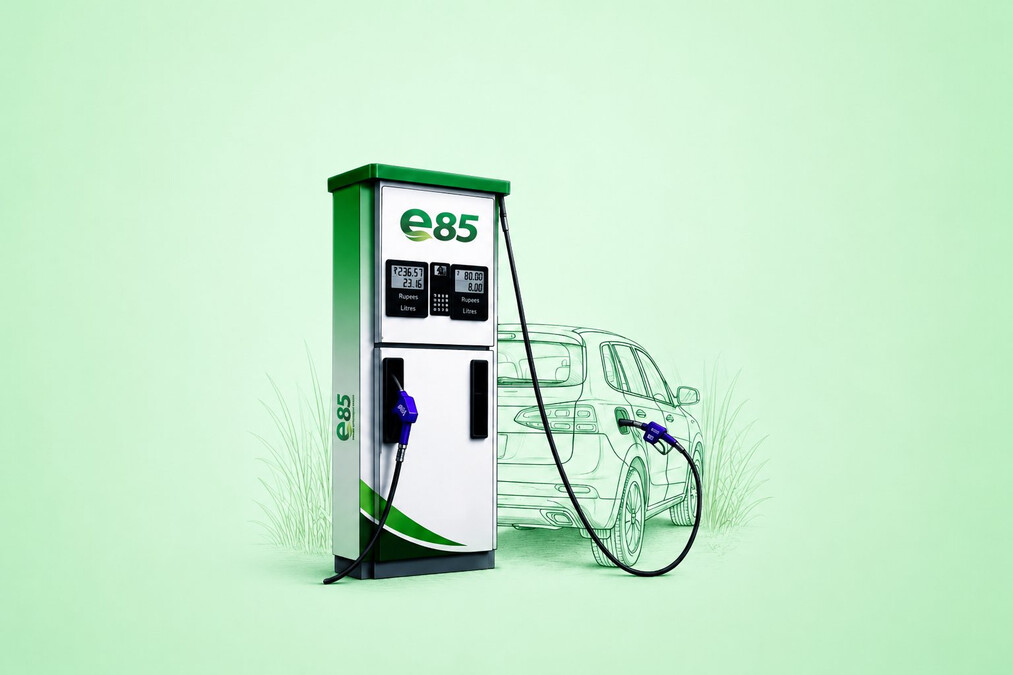
The Ministry of Petroleum and Natural Gas launches E85 fuel on World Environment Day. The launch highlights a high-ethanol blended fuel that is exclusively compatible with Flex-Fuel Vehicles and is presented with stated price and emission benefits.
E85 Fuel (High-Ethanol Blend Fuel):
| Dimension | Key Details |
|---|---|
| Fuel composition | E85 comprises 80–85% ethanol and 14–19% petrol. |
| Ethanol properties | Ethanol (ethyl alcohol) is a clear, volatile, and flammable liquid with a pungent taste. |
| Ethanol production | Ethanol is primarily produced through fermentation of biomass, like corn and sugarcane. |
| Vehicle compatibility | E85 applies exclusively to Flex-Fuel Vehicles (FFVs). |
| Flex-Fuel Vehicles (FFVs) | FFVs adapt automatically to blends ranging from E20 to E100. |
| Non-FFV restriction | Non-FFVs cannot use E85 due to engine damage risk. |
| Price feature | E85 provides for a cheaper per litre price than standard petrol. |
| Emission impact | E85 provides for 61% lower greenhouse gas emissions compared to fossil fuels. |
| Global reference | Brazil has used E85 and FFVs for decades. |
| Indigenous manufacturing | 100% Made-in-India FFVs are being launched. |
| Energy security | E85 provides for reduced crude oil import dependence. |
| Agriculture linkage | E85 provides for boosted demand for ethanol, supporting sugarcane and related sectors. |
| Fuel-type comparison | Petrol comprises 0% ethanol and 100% petrol, E20 comprises up to 20% ethanol and 80% petrol, and E85 comprises 80–85% ethanol and 14–19% petrol. |
| Vehicle-compatibility comparison | Petrol applies to all conventional petrol vehicles, E20 applies to all E20-compliant vehicles, and E85 applies exclusively to FFVs. |