|
Libex Coffee Hybrid
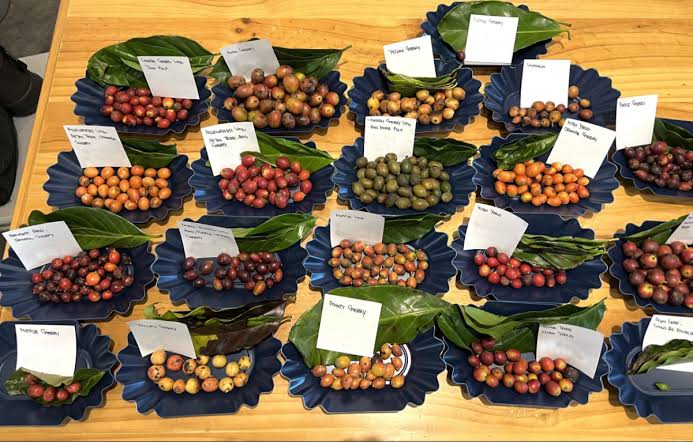
Scientists at the Royal Botanic Gardens, London identify a new coffee hybrid named Coffea × libex (Libex). The hybrid is created by crossing Liberica coffee and Excelsa coffee, with Indian samples and field expertise contributed by South India Coffee Company (SICC) and SICC Labs.
Coffea × libex (Libex) Coffee Hybrid :
| Dimension | Key Details |
|---|---|
| Identification authority | Libex coffee hybrid is identified by scientists at the Royal Botanic Gardens, London. |
| Hybrid name | The new coffee hybrid is called Coffea × libex (Libex). |
| Created by | Libex is created by crossing Liberica coffee and Excelsa coffee. |
| Indian contribution | South India Coffee Company (SICC) and SICC Labs contribute Indian samples and field expertise. |
| Significance: climate suitability | Libex provides for growth in warmer temperatures and tolerates a wider range of rainfall patterns than Arabica or Robusta. |
| Significance: yield and processing | Libex provides for higher yield, better outturn, and thinner pulp and parchment that makes post-harvest processing easier and improves coffee quality. |
| Current global coffee consumption | The world consumes about 17,000 tonnes of Arabica and 10,000 tonnes of Robusta (pre-roasting) every day. |
| Share in global production | Arabica and Robusta comprise more than 99.99% of global coffee production. |
| Issues with current varieties | Arabica and Robusta are increasingly vulnerable to rising temperatures and unpredictable rainfall. |
| India: main cultivated types | India primarily cultivates two main types: Arabica (high altitude, high value) and Robusta (stronger, used in blends). |
| India: global rank | India is the 7th largest coffee producer globally. |
| India: traditional producing regions and shares | Traditional regions comprise Karnataka (roughly 70–71% of India’s total coffee production), Kerala (about 21%), and Tamil Nadu (around 5%). |
| India: non-traditional areas | Non-traditional coffee areas comprise Araku Valley (Andhra Pradesh), Odisha, and the North East. |
| Administrative control | The Coffee Board of India functions under the Ministry of Commerce and Industry. |
| Legal basis | The Coffee Board of India is a statutory body established under the Coffee Act of 1942. |
| Headquarters | The Coffee Board of India headquarters is in Bengaluru. |
| Mandate and role | The Coffee Board of India mandate provides for promoting the production, quality, and export of Indian coffee, and its role comprises research, extension services, market intelligence, export promotion, and welfare for growers. |
| Composition | The Coffee Board of India comprises 33 members (including the Chairperson), representing growers, industry, labor, and state governments. |