|
Kaziranga National Park in Assam
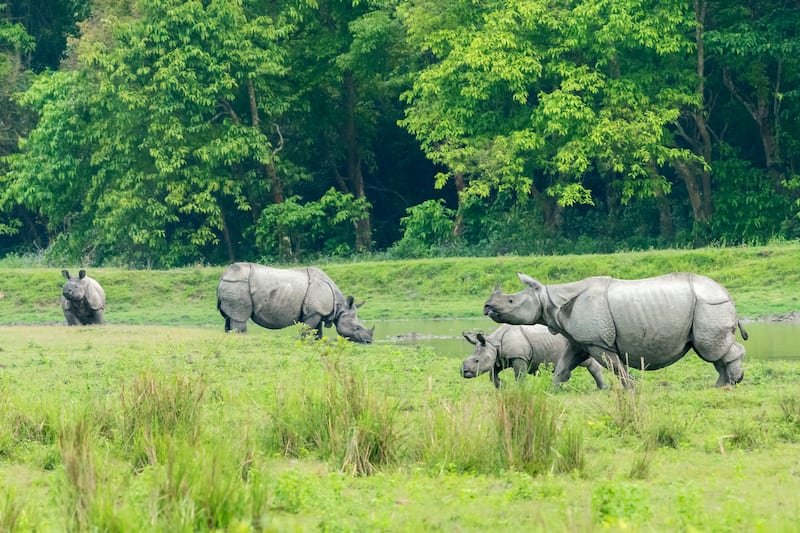
A study by the Birbal Sahni Institute of Palaeosciences (BSIP) examines reasons behind the decline and present confinement of megaherbivores, especially the Indian one-horned rhinoceros, to Kaziranga National Park. The study uses fossil evidence to state that the species was once widely distributed across the Indian subcontinent, but its distribution greatly reduces since the Holocene.
Kaziranga National Park (Assam) & BSIP Study :
| Dimension | Key Details |
|---|---|
| Study finding | The Indian one-horned rhinoceros was once widely distributed across the Indian subcontinent, but this distribution greatly reduced since the Holocene. |
| Geographic location | Comprises Assam’s Brahmaputra floodplains between the Brahmaputra River and the Karbi (Mikir) Hills. |
| International status | Declared a UNESCO World Heritage Site in 1985. |
| Protected area | Tiger Reserve. |
| Key biodiversity | The park hosts two-thirds of the world’s one-horned rhinos and comprises Tiger, Elephant, Asiatic Water Buffalo, and Eastern Swamp Deer. |
| Conservation status | Established as a Reserve Forest in 1905. |
| Bird conservation | Recognized Important Bird Area by BirdLife International. |