|
India–New Zealand FTA
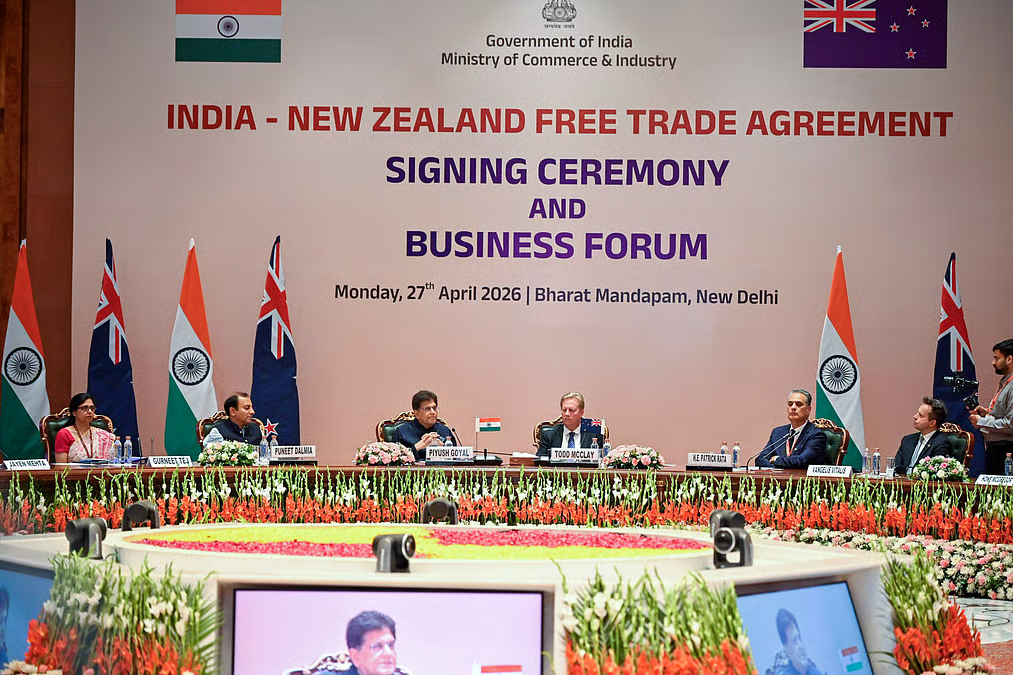
The India–New Zealand Free Trade Agreement is currently linked with India’s Viksit Bharat 2047 vision for global value chain integration and inclusive growth. The agreement is relevant for trade expansion, investment, mobility, and market access.
India–New Zealand Free Trade Agreement:
| Dimension | Key Details |
|---|---|
| Strategic Vision | The Free Trade Agreement aligns with India’s Viksit Bharat 2047 vision for global value chain integration and empowerment of MSMEs, farmers, women, and youth. |
| Duty-Free Access | New Zealand provides 100% duty-free access for all Indian exports. |
| Sectoral Benefit | Duty-free access applies to sectors such as MSMEs, textiles, leather, footwear, and gems. |
| FDI Commitment | New Zealand has committed USD 20 billion investment in India over the next 15 years. |
| Market Access | India provides market access in 70% of tariff lines covering 95% of New Zealand’s bilateral trade. |
| Protected Sectors | Approximately 30% of tariff lines remain in the exclusion category including dairy, sugar, vegetable products, and aluminium. |
| Rules of Origin | The agreement provides Product Specific Rules of Origin to prevent misuse of trade benefits. |
| Talent Mobility | The agreement provides student mobility, post-study work visas for STEM graduates, skilled professionals, and an annual quota of 5,000 temporary employment visas for skilled Indians. |
| AYUSH Recognition | New Zealand provides recognition and trade facilitation for Ayurveda, Yoga, and other Indian traditional medicine systems. |
| Other Cooperation | The agreement provides for agricultural productivity partnership and market access across 118 services sectors with Most-Favoured Nation treatment in 139 sectors. |
| Regional Trade Position | New Zealand is India’s second-largest trading partner in the Oceania region. |
| Trade Volume | Bilateral merchandise trade has grown by 49% to reach USD 1.3 billion in 2024–25. |
| Trade Balance | India maintains a positive trade balance with New Zealand. |
| Diaspora | The Indian diaspora in New Zealand comprises approximately 300,000 people, representing around 5% of New Zealand’s population. |