|
Elephanta Island Excavation
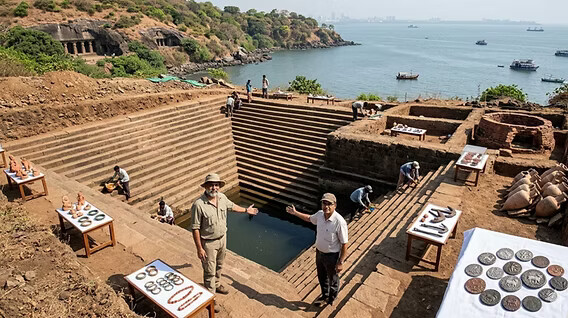
The Archaeological Survey of India discovers a 1500-year-old stepped reservoir on Elephanta Island near Mumbai. The finding highlights ancient water management and maritime activity on the island.
Elephanta Island Discovery
| Dimension | Key Details |
|---|---|
| Location | Is located in Mumbai Harbour in Maharashtra and is also known as Gharapuri. |
| UNESCO Site | Comprises Elephanta Caves dating to the 5th century dedicated to Lord Shiva. |
| Historic Ports | Comprises Morabandar, Rajbandar, and Shethbandar as key maritime localities. |
| Trade Significance | Provides for linkages with Rome and Mesopotamia as early as the 2nd century CE. |
| Stepped Reservoir | Provides for a T-shaped structure measuring 14.7 m in length and 6.7 m and 10.8 m in width. |
| Age | Provides for estimated age of about 1500 years. |
| Construction | Provides for use of stone blocks transported from the mainland. |
| Excavation Details | Provides for depth of 5 m exposing 20 steps. |
| Purpose | Provides for water storage in rocky terrain with low soil absorption. |
| Artifacts | Comprises brick structure, storage pot, terracotta figurines, glass and stone bangles, beads of carnelian and quartz, stone anchors, amphorae sherds, and torpedo jars. |
| Trade Evidence | Provides for Roman-style amphorae and West Asian torpedo jars used for wine, oil, and fish sauce. |
| Coins | Comprises silver, lead, and copper coins of Krishnaraja of the Kalachuri Dynasty. |
| Coin Features | Provides for seated bull motif on obverse and temple symbol with legend Sri Krishnaraja on reverse. |
| Historical Inference | Provides for confirmation of Kalachuri presence in western India during the 6th century CE. |