|
A Study Revises Mercury’s Diameter Contraction to 23 km
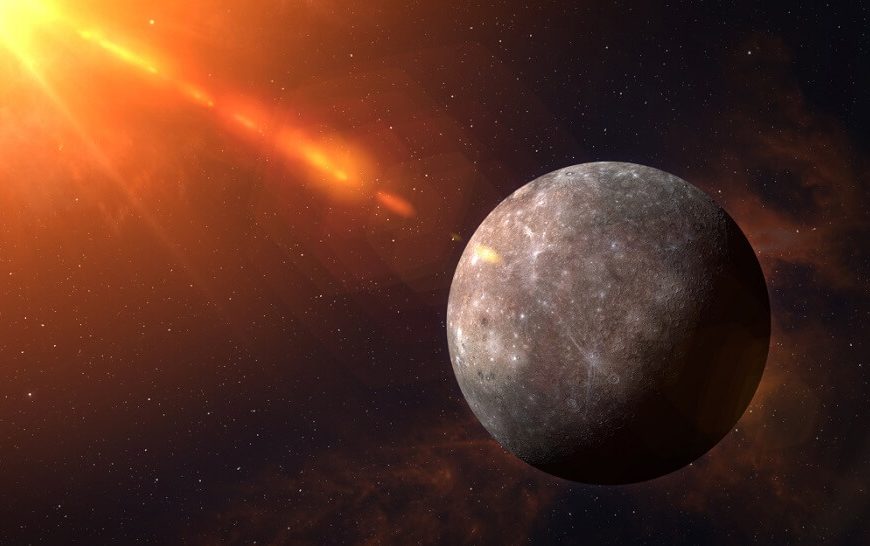
A new study published in Geophysical Research Letters suggests that Mercury may have contracted by up to 23 km in diameter, around 30% more than previous estimates. The study compares maps of contraction-related faults and surface roughness, and notes that fresh observations from the ongoing BepiColombo mission may provide further evidence.
Mercury Study and BepiColombo Mission:
| Dimension | Key Details |
|---|---|
| Key observation from analysis | Regions characterised by higher surface roughness exhibit fewer observable contraction features. |
| BepiColombo mission collaboration | BepiColombo is a collaborative mission between the European Space Agency (ESA) and the Japan Aerospace Exploration Agency (JAXA). |
| BepiColombo spacecraft | The mission includes two spacecraft: Mercury Planetary Orbiter (MPO), developed by ESA; and Mercury Magnetospheric Orbiter (Mio), developed by JAXA. |
| BepiColombo study targets | The spacecraft study Mercury’s surface, interior, magnetosphere, magnetic field, and geological evolution. |
| BepiColombo instrument | BepiColombo’s laser instrument is expected to provide data to help determine the extent of Mercury’s contraction as its interior cools. |
| Earlier Mercury missions | Mercury missions listed are: Mariner 10 (NASA, first spacecraft to visit Mercury, 1970s); MESSENGER (NASA, studied Mercury extensively, 2010s); and BepiColombo (ESA and JAXA, detailed investigation of Mercury, ongoing). |
| Mercury size and position | Mercury is the smallest planet in the Solar System, and it is the closest planet to the Sun. |
| Mercury core | Mercury possesses a disproportionately large iron core relative to its overall size. |
| Mercury contraction status | The planet has been undergoing gradual contraction as its interior cools. |
| Surface characteristics | Mercury's surface is heavily affected by impact cratering. |
| Geological features from contraction | This contraction produces geological features such as faults and scarps. |
| Natural satellites | Mercury does not have any natural satellites. |
| Magnetic field | Despite being a small rocky planet, Mercury possesses a global magnetic field. |