|
DRDO Demonstrates Indigenous GaN MMIC Technology
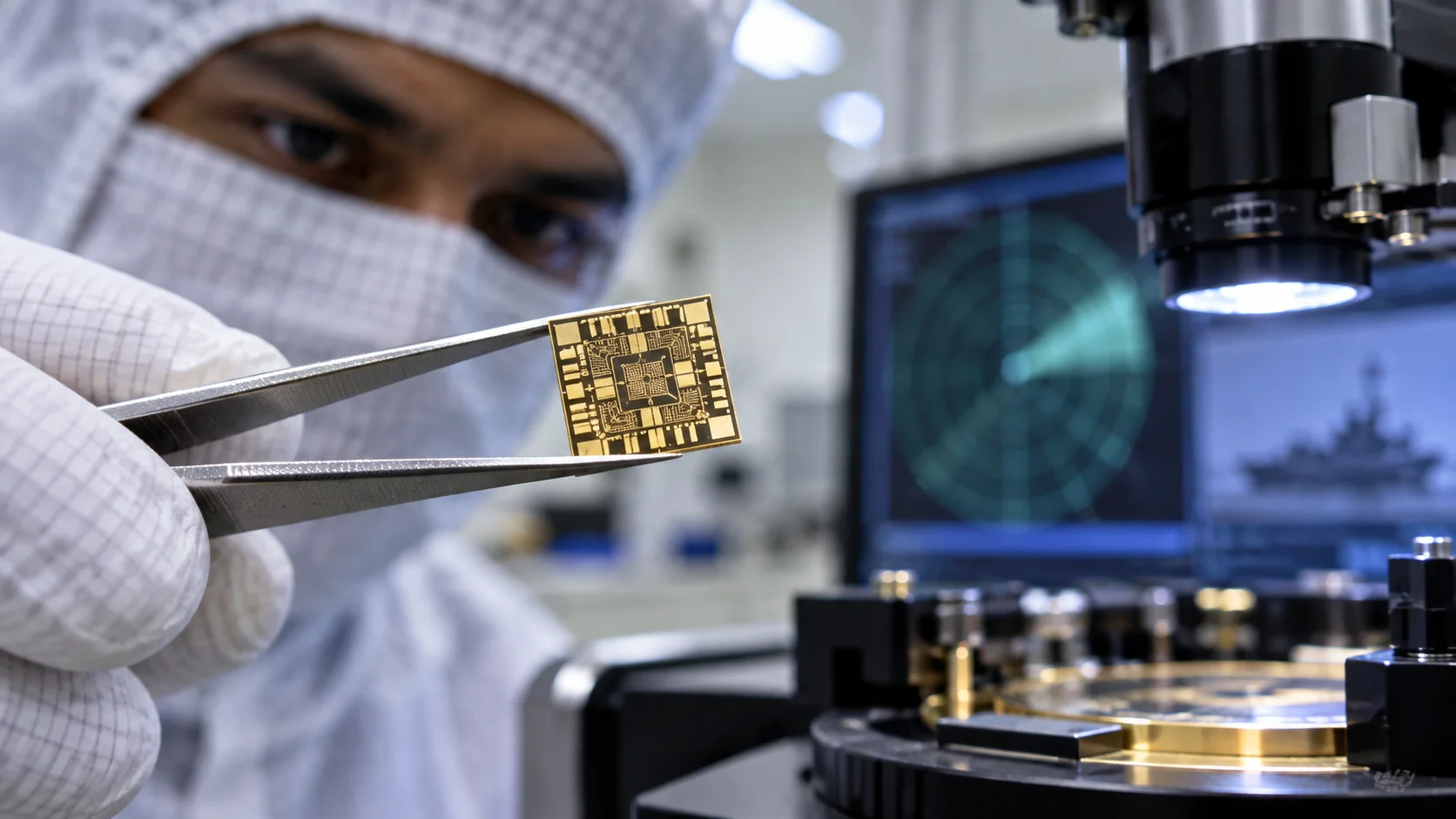
The Defence Research and Development Organisation (DRDO) successfully demonstrates and implements indigenous Gallium Nitride (GaN) Monolithic Microwave Integrated Circuit (MMIC) technology.
Indigenous GaN MMIC Technology:
| Dimension | Key Details |
|---|---|
| Material (GaN) | Gallium Nitride (GaN) comprises a wide-bandgap semiconductor material superior to Silicon (Si) and Gallium Arsenide (GaAs) for high-frequency and high-power applications. |
| Device Definition (MMIC) | Monolithic Microwave Integrated Circuit (MMIC) comprises an integrated circuit device operating at microwave frequencies of 300 MHz to 300 GHz, combining active functions such as amplifiers and switches onto a single semiconductor substrate. |
| Performance Benchmark | A single indigenous GaN chip measuring 3.5 mm×3 mm delivers up to 30 Watts of power, and operates at speeds up to 300 times faster than conventional silicon. |
| Developer and Pilot Production | The technology is developed primarily by DRDO’s Solid State Physics Laboratory (SSPL), New Delhi, and pilot production capabilities are established at the Gallium Arsenide Enabling Technology Centre (GAETEC), Hyderabad. |
| Frequency Coverage (S-band) | For S-band, the work comprises S-band GaN High Electron-Mobility Transistor (HEMT) power bars, Power Amplifiers, Low Noise Amplifiers (LNA), and switch MMICs. |
| Frequency Coverage (X-band) | GaN MMIC technology is demonstrated and implemented for applications extending up to the X-band of 8 to 12 GHz. |
| Substrate Technology | The technology is built using indigenous processes for growing and manufacturing 4-inch diameter Silicon Carbide (SiC) substrates as GaN-on-SiC, providing exceptional thermal dissipation. |
| Strategic Applications | Applications comprise next-generation radars, electronic warfare jammers, and space and guided missiles. |
| Next-Generation Radars Use-case | Transmit/Receive (T/R) modules powered by GaN MMICs generate higher RF output power, expanding detection ranges, enhancing target tracking, and shrinking physical array sizes in Active Electronically Scanned Array (AESA) radars. |
| Electronic Warfare Use-case | The technology enhances airborne and naval EW jammers capable of generating high-power directional jamming signals across wide bandwidths to blind hostile radar networks. |
| Space and Guided Missiles Use-case | The technology provides high-power density, thermal tolerance, and radiation hardness for compact radar seekers in precision-guided missiles and satellite communication (SatCom) payloads. |
| Strategic Autonomy | The capability eliminates critical reliance on foreign imports and bypasses Western denial regimes and export-control restrictions such as ITAR governing high-end semiconductor components. |
| Countries with Native GaN MMIC Design and Fabrication | The article lists the US, Russia, France, Germany, South Korea, China, and India as nations possessing native GaN MMIC design and fabrication technology. |