|
WMO’s Report Flags Persistent Groundwater Decline in India
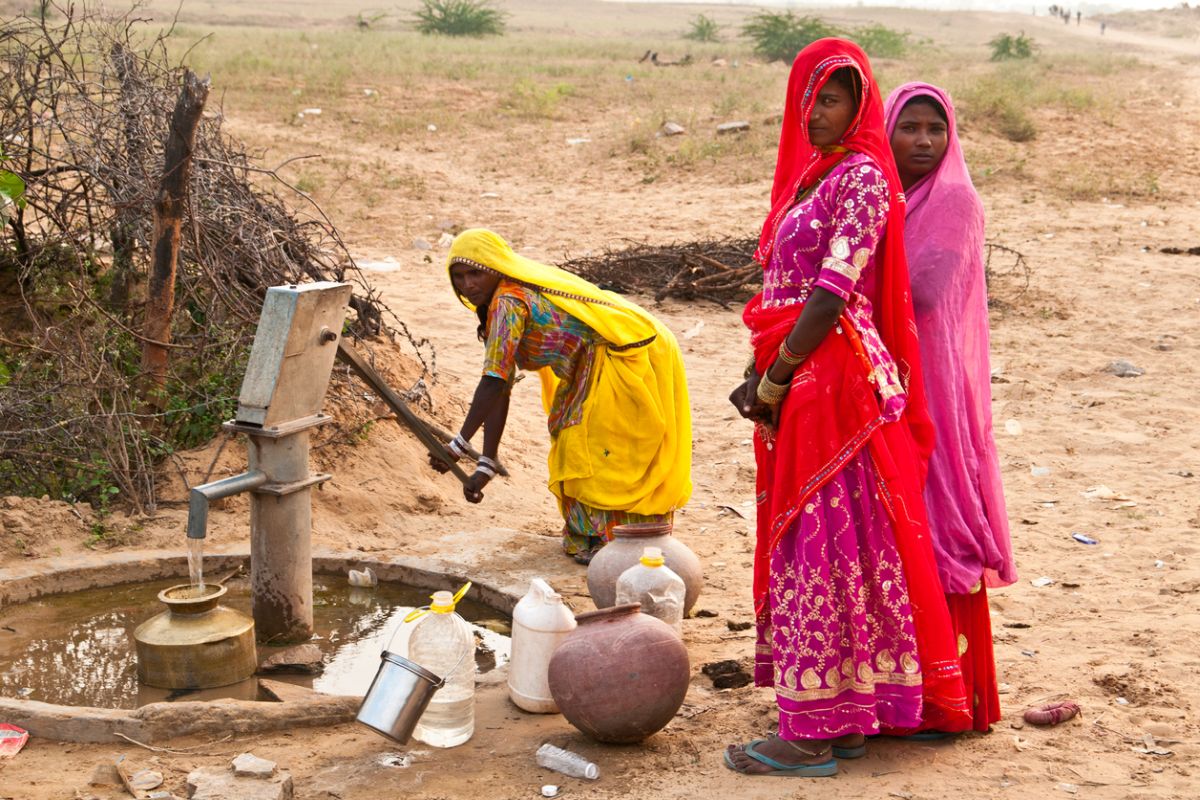
The World Meteorological Organization (WMO) publishes the State of Global Water Resources 2025 report, which flags persistent groundwater deficits in India during 2022-2025. The report presents quantified global and India-specific indicators on terrestrial water storage, river flows, glacier mass balance, and groundwater levels for 2025.
State of Global Water Resources 2025 Report:
| Dimension | Key Details |
|---|---|
| Report coverage | It provides a comprehensive quantitative overview of global water resources, with a focus on hydrological variability and trends. |
| Global water storage status | Satellite observations and hydrological models show that 42% of global land area has below-normal water storage in 2025. |
| Components covered under water storage measure | The measure covers water in rivers, streams, and lakes; groundwater; soil moisture; snow; and ice. |
| Global terrestrial water storage trend | Global terrestrial water storage shows a declining trend since 2014-2016. |
| Glacier mass loss status | For the fourth consecutive year, every major glaciated region on Earth loses ice mass. |
| Estimated glacier loss | The estimated loss during the 2025 hydrological year is about 408 gigatonnes, equivalent to roughly 1.1 millimetres of global sea-level rise. |
| Regions with severe glacier losses | Regions recording particularly severe glacier losses comprise Central Asia, western Canada, and the United States. |
| Global river dryness indicator | 2025 is one of the driest years for the world’s rivers in 35 years, with normal flows recorded across just 36% of global river basin area. |
| Global river basin flow classification | Global river basin area in 2025 comprises 36% with normal flows; 36% with below-normal or much-below-normal flows; 21% with above-normal or much-above-normal flows; and 7% with no data. |
| River basins with normal flows | The WMO finds that the 7 years from 2019 to 2025 have the smallest shares of river basins with normal flows since 1991. |
| Normal-flow shares | Normal-flow shares range from 34% to 38% during 2019-2025, compared with an average of 46% over 1991-2020. |
| Persistent groundwater deficits | Persistent groundwater deficits are observed during 2022-2025 in parts of the Americas, Europe, the Middle East, India, southern Africa, and Australia. |
| Driver identified for groundwater deficits | Over-abstraction is identified as an important driver in several regions. |
| Monitored wells status | Nearly two-thirds of monitored wells worldwide show conditions outside the historical norm in 2025, and the balance shifts further toward deficit compared with 2024. |
| Groundwater observation stations: below-normal | Globally, 34% of groundwater observation stations report below-normal to much-below-normal levels in 2025, compared with 25% in 2024. |
| Groundwater observation stations: above-normal | Around 31% of observation stations report above-normal to much-above-normal groundwater levels in 2025. |
| Water-related extreme events and deaths | Asia and Africa together account for at least half of all recorded water-related extreme events and more than 80% of reported associated deaths over the past 5 years. |
| India: terrestrial water storage | India records below-normal terrestrial water storage in 2025, particularly across the northern part of the country. |
| India: reservoir inflows and soil moisture | India records above- to much-above-normal reservoir inflows, while soil moisture is above or much above normal during the December-February and June-August assessment periods. |
| India: major river systems discharge | Among India’s major river systems, the Ganges, Godavari, Krishna, and Indus record above-normal to much-above-normal discharge in 2025. |
| India: groundwater recovery status | Higher river flows do not translate into a broad recovery of India’s deeper water reserves. |
| India: persistent groundwater deficits | The WMO finds persistent groundwater deficits in India during 2022-2025, with widespread below-normal to much-below-normal groundwater levels, particularly in northwestern India. |