|
India’s High-Containment Labs: NIV Pune BSL-4, DRDO Gwalior BSL-4, New Gujarat Facility
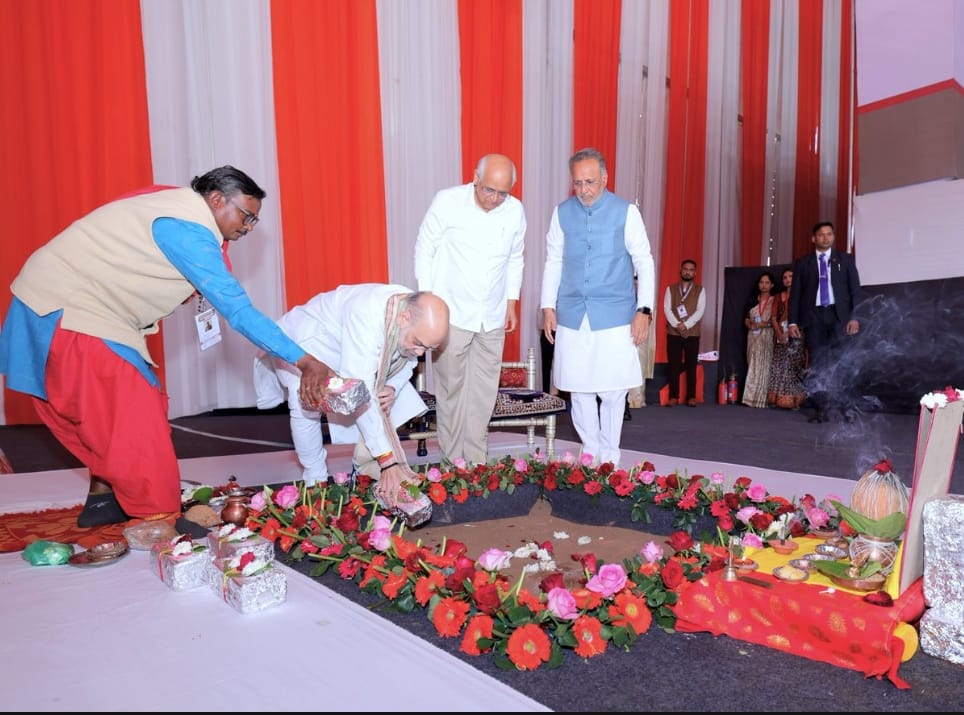
Union Home Minister Amit Shah lays the foundation stone for India’s first fully state-funded and state-controlled BSL-4 containment facility in Sector-28, Gandhinagar. The Gujarat BSL-4 complex is developed under the Gujarat State Biotechnology Mission and is designated as a national facility through an MoU signed by the Department of Biotechnology.
Gujarat State-Funded BSL-4 Containment Facility and India’s Biosafety Lab Network:
| Dimension | Key Details |
|---|---|
| Bio-Safety Level 4 | Provides for the highest level of biological containment to safely handle highly infectious pathogens, many lacking effective vaccines or treatments, under stringent international safety standards. |
| Funding and control | India’s first fully state-funded and state-controlled BSL-4 facility. |
| Status among civilian BSL-4 labs | Provides for the second civilian BSL-4 research lab in India. |
| Implementing mission | Governed by development under the Gujarat State Biotechnology Mission. |
| Cost and area | 11,000 sq metres and costing ₹362 crore. |
| Operating institution | Operates under the Gujarat Biotechnology Research Centre, which houses a BSL-2+ laboratory and played a key role during the Covid-19 pandemic by sequencing the SARS-CoV-2 genome. |
| Planning timeline | Planning for the BSL-4 lab begins in mid-2022. |
| Complex modules | BSL-4, BSL-3, BSL-2, ABSL-4, and ABSL-3 modules with advanced utilities and support systems. |
| Safety guidelines referenced | Regulated in line with international biosafety guidelines issued by the Centers for Disease Control and Prevention, National Institutes of Health, Department of Biotechnology, and Indian Council of Medical Research. |
| Research and response functions | Authorises advanced research into diagnostics, vaccines, and therapeutics, and provides for rapid outbreak investigation and response for deadly human diseases and zoonotic infections. |
| ABSL component and animal research | Provides for animal disease research and vaccine production using antibodies derived from animals; earlier such work required sending samples to ICAR–National Institute of High Security Animal Diseases. |
| National facility designation | Governed by an MoU signed by the Department of Biotechnology designating the lab as a national facility with guidance from expert institutions across India. |
| Functional civilian BSL-4 lab in India | Comprises one functional civilian BSL-4 laboratory at the National Institute of Virology, Pune, Maharashtra. |
| Defence-sector BSL-4 facility | Provides for a BSL-4 laboratory established by the Defence Research and Development Organisation in late 2024 in Gwalior, Madhya Pradesh, under the Defence Ministry. |
| High-security animal disease labs | ICAR–NIHSAD, Bhopal (currently rated ABSL-3+, with plans announced in June 2025 to upgrade to ABSL-4) and ICAR–ICFMD, Bhubaneswar, Odisha (operates with an ABSL-3Ag rating). |
| Global count of BSL-4 labs | About 69 BSL-4 laboratories globally that are operational or under development. |
| VRDL scheme biosafety labs | Ministry of Health and Family Welfare, through the Department of Health Research, authorises 165 approved labs under VRDL: 154 BSL-2 and 11 BSL-3. |
| ICMR-led biosafety labs | Indian Council of Medical Research establishes 21 biosafety laboratories across its institutes: 1 BSL-4, 8 BSL-3, and 12 BSL-2. |
| DST-supported high-containment labs | The Department of Science and Technology, via the Anusandhan National Research Foundation, funds five BSL/ABSL-3 laboratories under the IRHPA programme to strengthen research in high-priority areas. |
| DBT biosafety labs | Department of Biotechnology sets up 26 biosafety laboratories across DBT institutes. |
| ICAR biosafety labs | Indian Council of Agricultural Research establishes 9 biosafety laboratories. |
| CSIR biosafety labs | Council of Scientific and Industrial Research creates 11 biosafety laboratories across its network. |