|
India–New Zealand Announce Strategic Partnership ‘Roadmap to 2030’
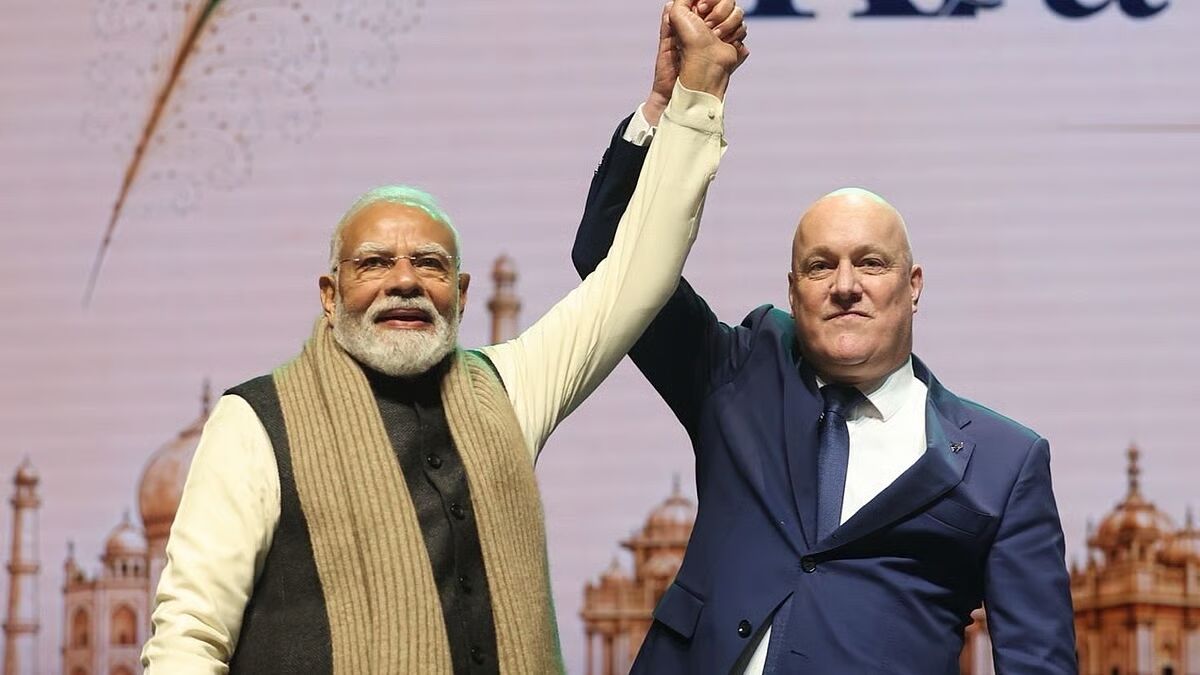
The prime ministers of India and New Zealand meet in Auckland and announce the India–New Zealand Strategic Partnership – Roadmap to 2030. The meeting produces multiple documents and announcements covering maritime cooperation, disaster management, trade, tourism, culture, and research collaboration.
India–New Zealand Strategic Partnership :
| Dimension | Key Details |
|---|---|
| Strategic Partnership and Roadmap to 2030 | Provides for cooperation in trade, defence, tourism, culture, and Indo‑Pacific priorities. |
| Maritime Cooperation (India–NZ Defence) | Provides for a framework for Indo‑Pacific maritime dialogue, information exchange, and joint activities. |
| Implementation Arrangement in Hydrography and Nautical Cartography | Provides for joint production of navigational charts, hydrographic data sharing, training, and capacity building. |
| Mutual Logistics Support (Navies) | Provides for reciprocal logistics support between the Indian Navy and the New Zealand Defence Force during approved operations. |
| Joint Working Group on Counter‑Terrorism | Provides for information exchange and coordinated efforts against terrorism. |
| Disaster management cooperation (NDMA–NEMA) | Provides for collaboration between the National Disaster Management Authority of India and the National Emergency Management Agency (NEMA) of New Zealand on disaster risk management, with emphasis on earthquakes, tsunamis, coastal hazards, and resilience. |
| Animal Husbandry and Dairying cooperation | Provides for enhanced cooperation in animal husbandry and dairying through technical collaboration, knowledge exchange, and best practices. |
| Tourism arrangement (Ministry of Tourism, India–MBIE, NZ) | Provides for a memorandum of arrangement in tourism between the Ministry of Tourism of India and the Ministry of Business, Innovation and Employment of New Zealand. |
| India–NZ Joint Action Plan on Sport | Provides for cooperation in sports science, medicine, and athlete development. |
| National Maritime Heritage Complex (NMHC) collaboration | Provides for collaboration on NMHC projects at Lothal, Gujarat, involving the Lothal–NZ Museum component. |
| Cultural cooperation | Provides for exchanges in arts, heritage, and cultural initiatives between the Ministry of Culture of India and the Ministry of Culture and Heritage of New Zealand. |
| Doubling bilateral trade target | Mandates a doubling bilateral trade target of NZD 7 billion by 2030 under an FTA to expand market access. |
| Maritime Security Dialogue | Provides for establishment of a maritime security dialogue to strengthen cooperation, coordination, and information exchange. |
| NZ joining IPOI (Maritime Security Pillar) | Provides for New Zealand joining the Indo‑Pacific Oceans Initiative (IPOI) Maritime Security Pillar with a focus on combating Illegal, Unreported and Unregulated (IUU) fishing. |
| NZ joining Global Biofuels Alliance | Provides for cooperation for sustainable biofuels and clean energy transition. |
| Kiwifruit Action Plan and Centres of Excellence | Comprises centres of excellence in Nagaland and Uttarakhand. |
| Polar and ocean research MoU (NCPOR–University of Canterbury) | Provides for Antarctic research, joint studies, and academic exchange between the National Centre for Polar and Ocean Research (NCPOR), Goa and the University of Canterbury, New Zealand. |
| Food technology MoU (NIFTEM-K–Massey University) | Provides for cooperation in food technology, research, and student mobility between NIFTEM-K, Kundli and Massey University, New Zealand. |