|
India Hosts World Circular Economy Forum 2026, First in South Asia
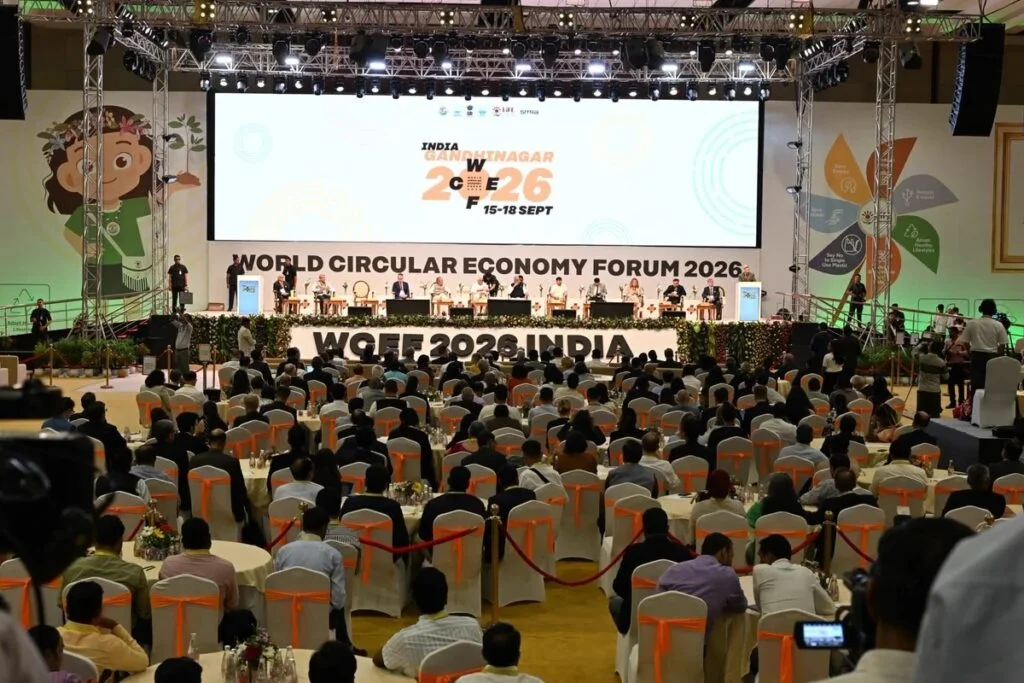
India hosts the 10th edition of the World Circular Economy Forum (WCEF 2026) at Mahatma Mandir in Gandhinagar, Gujarat. The event marks the first time the global flagship WCEF is hosted in South Asia.
World Circular Economy Forum 2026:
| Dimension | Key Details |
|---|---|
| Theme | WCEF 2026 is governed by the theme, “Circular Economy: Transition for People and Prosperity”. |
| Organisers | WCEF 2026 is jointly organised by: Central Pollution Control Board (CPCB); Finnish Innovation Fund Sitra; the Government of Finland; the Ministry of Environment, Forest and Climate Change (MoEFCC); the Government of Gujarat; and the Gujarat Pollution Control Board (GPCB). |
| Forum framework | WCEF 2026 is structured around a “2+2 day” dual-format framework. |
| Circular economy definition | Circular economy comprises an economic system that departs from the “Take-Make-Dispose” linear economic model to a closed-loop system. |
| Core principles of circular economy | Circular economy provides for three core principles: eliminate waste and pollution; circulate products and materials through the 6Rs (Reduce, Reuse, Repair, Refurbish, Remanufacture, and Recycle); and regenerate nature by returning biological nutrients to natural ecosystems (e.g., composting, bio-refining). |
| Economic alignment | Circular economy authorises decoupling economic activity from the consumption of finite natural resources, improving raw material security, and creating “green jobs” in remanufacturing and resource recovery. |
| Domestic paradigms referenced | WCEF 2026 bridges India’s domestic environmental paradigms with global expertise, venture capital, and cross-border clean-tech partnerships, comprising Mission LiFE, the 3Rs (Reduce, Reuse, Recycle), and Swachh Bharat Abhiyan. |
| Main forum programme structure | The main forum programme comprises 4 plenary sessions and 16 parallel sessions. |
| Expo space | WCEF 2026 features a curated Expo Space showcasing practical, scalable circular technologies and business models from Indian and international organizations. |
| Accelerator and partner sessions format | Accelerator and partner sessions are hosted in Gandhinagar, online, and through satellite WCEF Studios worldwide to translate policy frameworks into actionable industrial roadmaps. |
| Four core thematic tracks | WCEF 2026 comprises four core thematic tracks: People, Business, Governance, and Growth. |
| People track focus areas | The People track provides for a focus on inclusion, skills and jobs, workforce upskilling for green jobs, integrating informal waste workers into formal waste management systems, and youth leadership and behavioral changes for sustainable consumption models. |
| Business track focus areas | The Business track comprises sustainable product design, industrial symbiosis, material recovery, and remanufacturing across textiles, electronics, plastics, and automotive, and promotes shifting from selling physical products to offering product-as-a-service (PaaS). |
| Governance track focus areas | The Governance track focuses on regulatory enablers, including Extended Producer Responsibility (EPR) frameworks, circular public procurement, harmonizing cross-border waste trade standards, and metrics, life-cycle assessments, and science-based policy interventions to prevent non-tariff trade barriers. |
| Growth track focus areas | The Growth track addresses scaling circular solutions through blended finance, sovereign green bonds, risk-guarantee mechanisms, and venture capital, and connects public-private investment frameworks to build resilient material supply chains across developing economies. |
| Platform for Global South | WCEF 2026 provides a platform for Global South nations to co-design circular economy policies, ensuring that international environmental standards account for local economic realities and informal sector dynamics. |