|
India Adds 5 Sites to UNESCO Tentative List
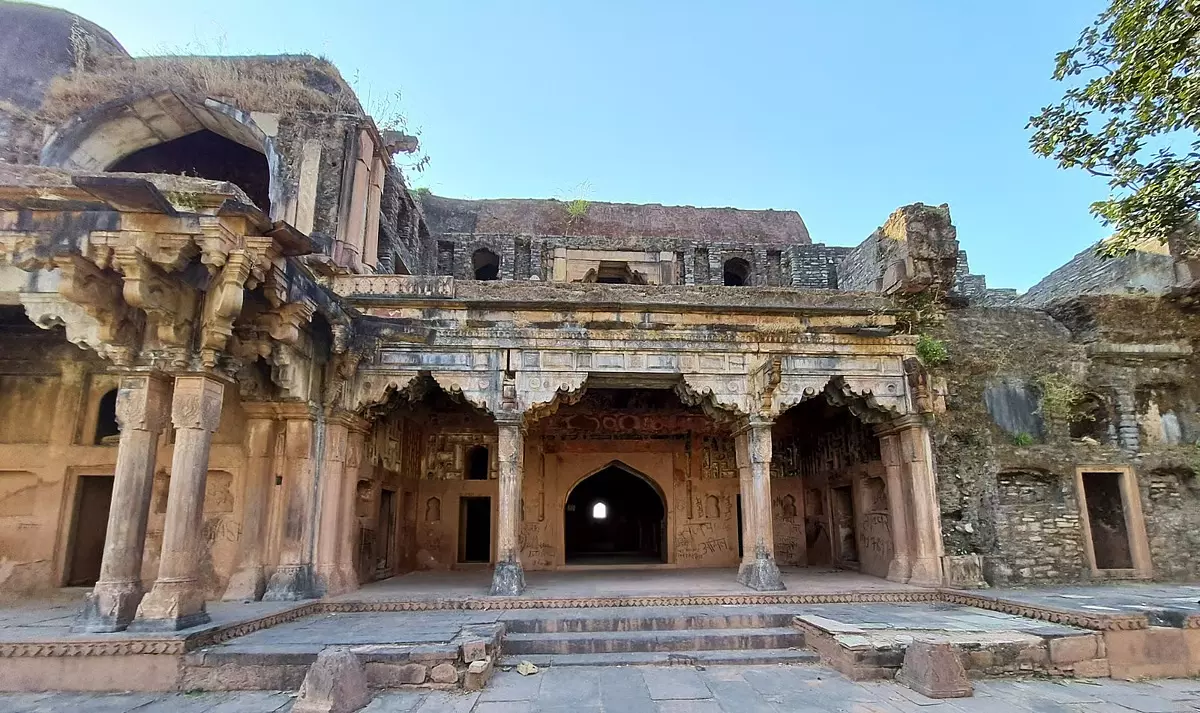
5 new heritage site proposals are added to India’s UNESCO Tentative List, taking the total to 78 sites. The additions include four proposals from Madhya Pradesh and one serial transnational nomination spanning India and South Africa.
India’s 5 New Additions to UNESCO Tentative List:
| Dimension | Key Details |
|---|---|
| Added proposals | The additions comprise Bagh Cave Paintings, Ginnorgarh Fort, Group of Temples in the Chambal Valley, Udaigiri Caves, and Sites of Satyagraha in India and South Africa. |
| Bagh Cave Paintings: location and nature | Bagh Cave Paintings are rock-cut Buddhist caves located in Dhar, Madhya Pradesh, on the southern slope of the Vindhyan Range adjacent to the Baghni River. |
| Bagh Cave Paintings: quantitative details | The site comprises 9 caves and dates to the 4th to 6th centuries CE. |
| Bagh Cave Paintings: key feature and themes | The site is renowned for Buddhist murals, particularly those in Cave 4 known as Rang Mahal, illustrating royal courts, processions, musicians, dancers, and aspects of social life. |
| Bagh Cave Paintings: artistic and geological significance | The murals demonstrate connections with the Ajanta painting tradition while maintaining distinct regional characteristics, and a sandstone outcrop within an otherwise basaltic region influences architectural design and preservation of the murals. |
| Ginnorgarh Fort: location and association | Ginnorgarh Fort is located in Sehore, Madhya Pradesh, within the forested Ratapani region, and serves as the fortified capital of the Raj Gond rulers. |
| Ginnorgarh Fort: key features | The fort includes extensive fortifications, palatial structures, stepwells, and reservoirs. |
| Ginnorgarh Fort: significance | The site demonstrates Gond traditions in governance, defence, architecture, and water management, and emphasizes indigenous Gond heritage and an integrated water-management system. |
| Group of Temples in the Chambal Valley: location and components | The Group of Temples in the Chambal Valley is located in Morena, Madhya Pradesh, and comprises Bateshwar, Padavali, and Kakarmath. |
| Group of Temples in the Chambal Valley: period and architecture | The site dates to the 8th to 11th centuries CE and comprises early medieval Nagara-style temple architecture. |
| Group of Temples in the Chambal Valley: associations and key fact | The site has historical associations with Gurjara-Pratihara and Kachchhapaghata traditions, and Bateshwar is notable for its extensive cluster of temples. |
| Group of Temples in the Chambal Valley: significance | The site represents the evolution of temple architecture, sculpture, and temple-building traditions in the Chambal region. |
| Udaigiri Caves: location, period, and number | Udaigiri Caves are located in Vidisha, Madhya Pradesh, date primarily to the Gupta period spanning the late fourth to early fifth century CE, and comprise 20 excavated caves. |
| Udaigiri Caves: features and notable sculpture | The site includes shrines, inscriptions, and monumental sculptures, including the Varaha relief depicting Vishnu. |
| Udaigiri Caves: significance | The site provides evidence of early Hindu sacred architectural forms, development of religious traditions, patterns of royal patronage, and interaction between religious practices and the surrounding landscape. |
| Sites of Satyagraha in India and South Africa: nature and purpose | This is a serial transnational heritage nomination that traces the evolution of Mahatma Gandhi’s concept of Satyagraha. |
| Sites of Satyagraha in India and South Africa: countries and total components | The nomination applies to India and South Africa and comprises 9 components. |
| Sites of Satyagraha in India and South Africa: South Africa components | The South Africa components comprise Pietermaritzburg Station and Phoenix Settlement. |
| Sites of Satyagraha in India and South Africa: India components | The India components comprise Mahatma Gandhi Satyagraha Smarak, Sabarmati Ashram, Mani Bhavan, Harijan Sevak Sangh, Sevagram Ashram, Aga Khan Palace, and Gandhi Smriti. |
| Sites of Satyagraha in India and South Africa: representation of evolution | Pietermaritzburg represents the origins of Satyagraha in response to racial discrimination, Phoenix Settlement represents experimentation with communities founded on principles of truth and non-violence, and the Indian sites illustrate consolidation, mass civil disobedience, and institutionalization of the Satyagraha movement. |