|
DRDO’s Netra Airborne Early Warning and Control (AEW&C) system
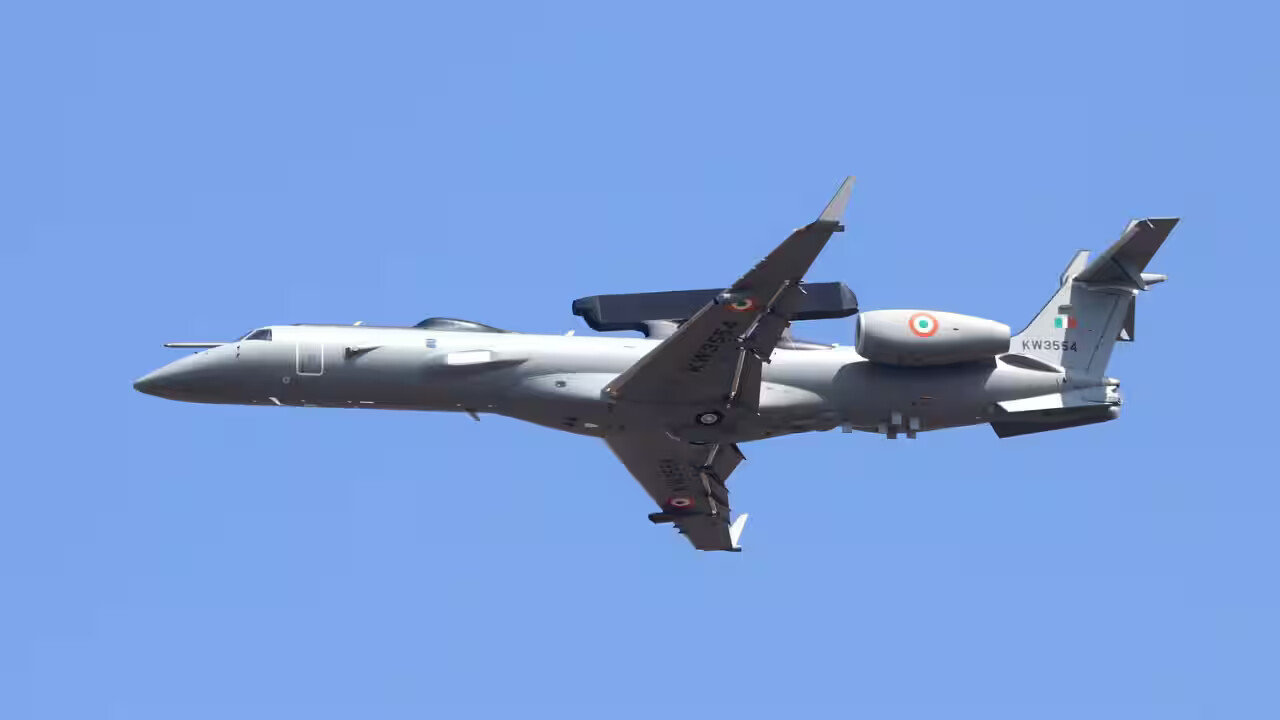
The indigenously built Netra Airborne Early Warning and Control (AEW&C) system secures final operational clearance. The system is developed by DRDO in collaboration with the Indian Air Force and certification agencies, and it is relevant as a current defence capability update.
Netra Airborne Early Warning and Control (AEW&C) system:
| Dimension | Key Details |
|---|---|
| Type | It comprises an Airborne Early Warning and Control (AEW&C) system. |
| Indigenous Status | It is India’s first indigenously developed AEW&C system. |
| Purpose | It provides comprehensive situational information to controllers onboard the aircraft and to ground-based stations, enabling coordinated air defence operations. |
| Role | It provides commanders with a real-time picture of the aerial battlefield. |
| Developed by | It is developed by DRDO in collaboration with the Indian Air Force, certification agencies such as CEMILAC and DGAQA, and several Indian industry partners. |
| Mounted on | It is mounted on Brazilian-made Embraer EMB-145 aircraft. |
| Function | It functions as an airborne surveillance and battle management platform capable of detecting, tracking, and identifying airborne threats over long distances. |
| Radar Technology | It is equipped with an indigenous Active Electronically Scanned Array (AESA) radar, allowing it to detect and track multiple targets simultaneously with greater speed and accuracy. |
| Integrated Systems | It is integrated with advanced systems: Secondary Surveillance Radar (SSR), Electronic Support Measures (ESM), Electronic Counter Measures (ECM), secure communication systems, Line-of-Sight (LOS) and Beyond-Line-of-Sight (BLOS) data links, and a self-protection suite. |
| Air-to-Air Refuelling | It has air-to-air refuelling capability, allowing it to remain airborne for extended surveillance missions. |
| Technical Domains Required | Developing the Netra platform requires expertise across multiple domains, including radar technology, electronic warfare, avionics, mission software, aircraft integration, and systems engineering. |
| Operational Significance | It is considered a force multiplier by acting as an airborne command and control centre that provides early warning of incoming aircraft, missiles, and drones, and enables rapid coordination of large-scale air, border, and maritime defence missions. |