|
2026 Nobel Prize in Physiology or Medicine
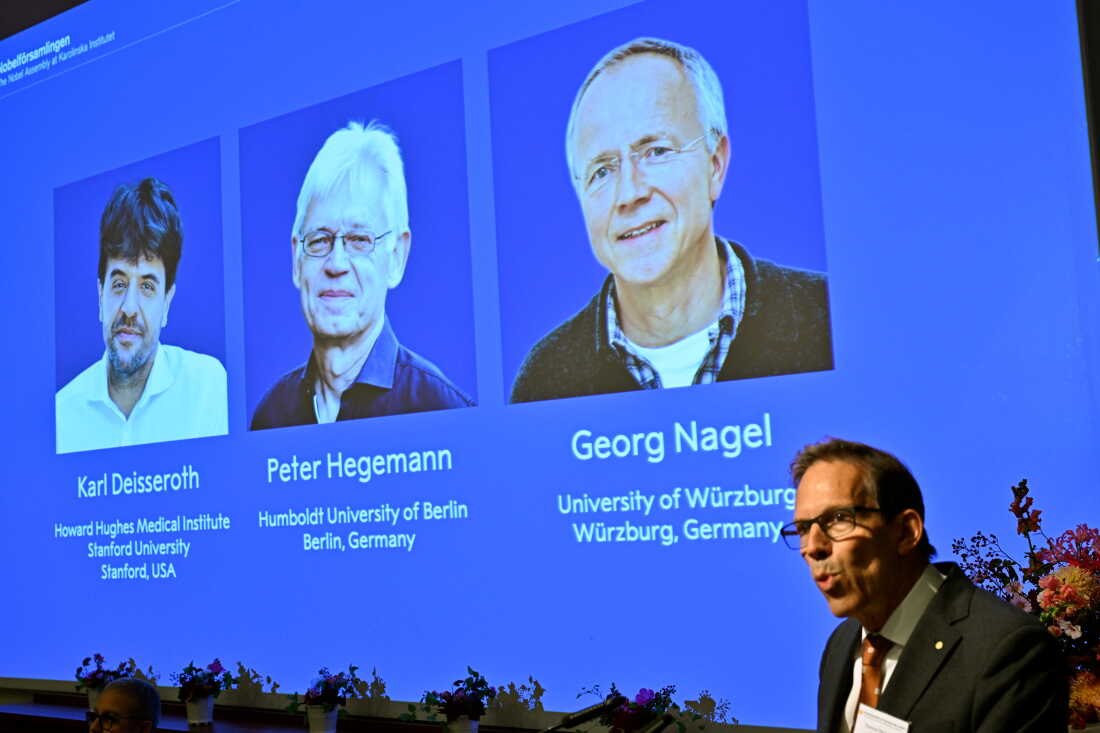
The 2026 Nobel Prize in Physiology or Medicine is jointly awarded to Karl Deisseroth, Peter Hegemann, and Georg Nagel for “discoveries concerning light-gated ion channels and optogenetics.” The award recognises discoveries that enable switching specific nerve cells on and off using light through optogenetics.
2026 Nobel Prize for Light-gated Ion Channels & Optogenetics:
| Dimension | Key Details |
|---|---|
| Laureates and positions | The laureates comprise Karl Deisseroth (born 1971), Professor of Bioengineering and Psychiatry & Behavioral Sciences at Howard Hughes Medical Institute and Stanford University, USA; Peter Hegemann (born 1954), Professor of Neuroscience at Humboldt University of Berlin, Germany; and Georg Nagel (born 1953), Professor of Molecular Plant Physiology at the University of Würzburg, Germany. |
| Light-gated ion channels | Light-gated ion channels comprise membrane proteins that change shape when a specific wavelength of light hits them, opening to allow ions to flow through. |
| Optogenetics | Optogenetics comprises switching specific cells on or off using light by placing light-sensitive proteins called opsins into targeted cells. |
| Origin idea in article | Francis Crick’s idea provides for activating individual nerve cells to study mechanisms underlying human consciousness, using light as a control mechanism for extremely rapid nerve signals. |
| Study organism and quantitative detail | Chlamydomonas comprises a unicellular alga that detects light through an orange “eyespot” and swims toward light within half a millisecond, while the human eye’s reaction time is about 10 milliseconds. |
| Channelrhodopsins and electrophysiology | Channelrhodopsin-1 and channelrhodopsin-2 (ChR-2) comprise ion channels that open in response to light, and ChR-2 opens within 0.2 milliseconds of a light pulse to let positive ions flow and produce an electrical signal. |
| Key publication milestones | Hegemann and Nagel’s results are published in 2003 proposing the protein as a tool for generating electrical impulses using light, Deisseroth’s rat nerve cell result is published in 2005, and the technique is formally named “optogenetics” in 2006. |
| Brain cell count | The adult human brain comprises roughly 90 billion nerve cells. |
| Circuits identified using optogenetics | Optogenetics authorises separating and isolating brain circuits, identifying those governing pain, social behaviour, thirst, food consumption, reward, attention, circadian rhythm, and fever. |
| Ongoing trial | In ongoing trials for retinitis pigmentosa, a channelrhodopsin-like protein placed in a blind person’s retina restores partial vision, enabling them to discern and grasp objects on a table using special light-emitting glasses. |
| Technical safeguards | Experts outline three safeguards: optogenetics requires genetically modifying neurons to produce light-sensitive proteins human cells do not naturally make; the scalp and skull block most visible light and scattered penetration makes precise targeting difficult from outside the body; and changing specific neurons’ activity does not by itself grant control over a person’s thoughts or actions. |