|
US-Saudi Arabia Sign 30-Year Civil Nuclear Cooperation Pact Under Section 123 Agreement
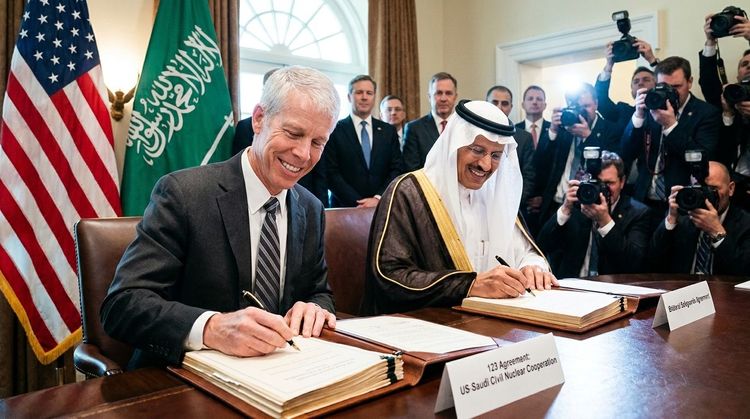
The United States and Saudi Arabia authorise a 30-year peaceful civil nuclear cooperation agreement under a Section 123 Agreement of the US Atomic Energy Act. The agreement provides for taking effect only if Saudi Arabia joins the U.S.-brokered Abraham Accords.
Section 123 Agreement (US Atomic Energy Act):
| Dimension | Key Details |
|---|---|
| Conditionality for taking effect | The US-Saudi agreement provides for taking effect only if Saudi Arabia joins the U.S.-brokered Abraham Accords. |
| Legal basis | The agreement is governed by a Section 123 Agreement under the US Atomic Energy Act. |
| Mandatory prerequisite | A Section 123 Agreement provides for a mandatory legal prerequisite before the US can transfer nuclear materials, reactors, equipment, technology, or fuel to another country for peaceful civilian purposes. |
| India and the 123 Agreement | India has been authorised under a 123 Agreement signed in 2008, enabling civilian nuclear cooperation. |
| India and NPT linkage | The 2008 123 Agreement authorises civil nuclear trade despite India not being a signatory to the Non Proliferation Treaty. |
| IAEA safeguards | The 2008 123 Agreement provides for India-specific safeguards under the International Atomic Energy Agency (IAEA). |
| International nuclear commerce | The 2008 123 Agreement authorises opening the door for international nuclear commerce with India. |
| Non Proliferation Treaty (NPT) | The NPT comprises provisions to prevent the spread of nuclear weapons, promote the peaceful use of nuclear energy, and achieve global nuclear disarmament. |